Christ, The Way
“I am the Way, the Truth and the Life. No one comes to the Father except through Me.” John 14:6
In contemporary Christianity, Jesus’ announcement that He is The Way is often taken to mean that it is belief in Christ which provides The Way to heaven. There is a sense that Christ will provide us with the a step-by-step Plan for Our Life: He will give us what we need to succeed and to fulfill our potential, and to secure eternal life. All too often, this understanding leads to a worldly interpretation of The Way as something which Christ provides — the teaching becomes an affirmation of a prosperity Gospel; a bonus add-on, a gift given to Christians because they’ve made a particular choice or said particular words.
Such an understanding is actually what the early Church would have termed ‘pagan’: it is an understanding which undermines the centrality of Christ’s Way in the spiritual transformation that underpins discipleship. The Way is not a reward for ‘believing’ in Christ; The Way is the reality of Christ that is, and leads to, a complete reorientation of being.
This was understood clearly in the early Church. In the decades before it was called Christianity, the new faith in the Resurrection of Jesus, the Messiah and the Son of Man, was known as “The Way.”
In the Book of Acts, the people “belonging to the Way” (Acts 9:2) are persecuted by Saul, the zealous Pharisee.
This early Name for the community of Christ points to much deeper truths – truths of Scripture which addressed the errors and the lost-state of Man – errors cast as seed-tares amongst the wheat at the time of the Fall, and which had sprouted into full vigour, via the cultural influences of the Greco-Roman age, at the time of Christ’s earthly coming.
The Hebrew noun for ‘way’ is derek, and the word is used frequently in the Hebrew Bible – a Way of Righteousness. When it is used in these Hebrew texts, derek is as much about a way of life as it is about a path; it is both interior and exterior at the same time. The prophet Isaiah speaks of the Way of Holiness (Isaiah 35:8) – a path, both literal and spiritual, upon which God’s scattered and exiled people will return Home to Jerusalem.
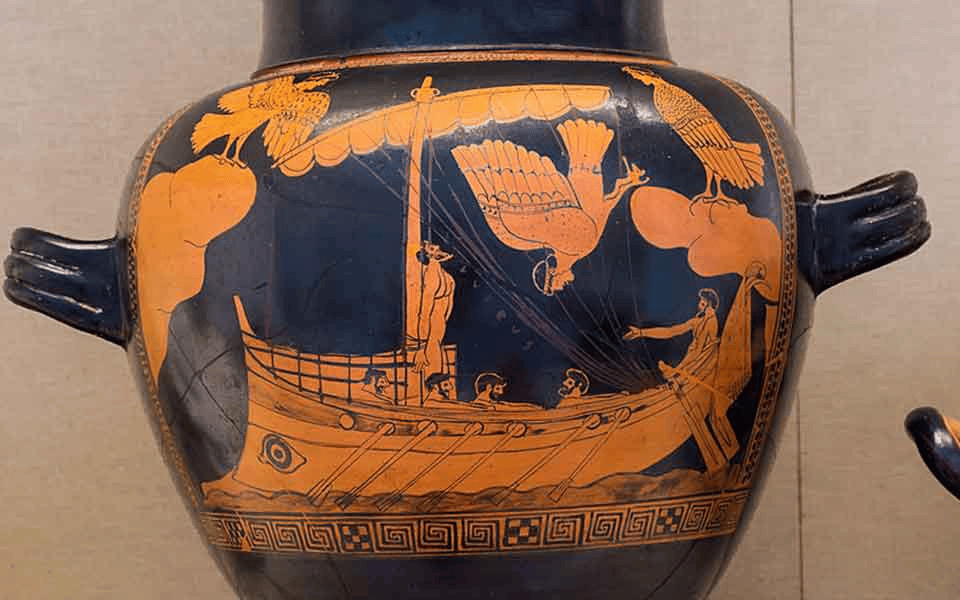
The Greek word for ‘the Way’, as used in the New Testament scriptures, is hodos. This term has many meanings: way, path, journey or road. The language of travel and roads played a significant role in the literature and story-telling of the ancient Greeks: the term holds within it a cosmos in which humans, while increasingly making their own choices and decisions in the world, were still governed by the gods, controlled by destiny and the Fates. This term hodos takes us back in time to the Homeric epics: hodos as paths to the underworld; hodos as sea-lanes and maritime voyages.
But Jesus makes the claim that He is The Way – not merely one way among many. Outwardly, He is The Way in the desert – a place with no known roads; inwardly, He is The Way into the landscape of the soul.
In order to understand the astonishing quality of Christ’s unique claim, we have to go back to the Greek cultural record that informed Rome – and which had profound influence over many of the ancient cultures in which Rome held its Empire. In brief, we have to see how Jesus set himself up to be The Way in contradistinction to the ways of the Greeks.
We have to go back to Herakles/Hercules, and his many labours – in multiple far-flung places – to expiate and make amends for his guilt: driven temporarily mad by the goddess Hera (and her jealousy), Herakles kills his own children and his wife, Megara, and is thus set on numerous paths (hodos) to atone for his crime. In the process, Herakles becomes the archetypal Greek Hero – well-travelled, acquainted with the nefarious ways of the world, honed and tested by multiple death-defying (not death-accepting) feats; an explorer and conqueror of known and unknown worlds.
We also must go back to Homer’s The Odyssey (yes, the subject of Christopher Nolan’s latest 2026 film). The word ‘odyssey’ means ‘wanderings’; it is also patronymic — it is the wanderings of a wanderer who is named Odysseus. The name Odysseus is an expression of the Greek word odussomai (ὀδύσσομαι) — the one who is hated; the one who causes pain. Odysseus, this Hero, is the name of a cursed person: a person who has caused the gods’ to hate him, who works against their divine purposes and thus causes harm. A man who does amazing things but is not actually able to accomplish what he sets out to do (i.e., bring his men home to safety). The word hodos is at the root of the word odussomai. The resonance among these meanings is significant: the cursed one is the wandering one; the one who wanders and who has been made to — has been punished by being made to — wander.
Why is Odysseus being punished? Why has he been made to wander — for years and years without a home, without a place to belong?
In the first line of Homer’s majestic epic poem, we hear the following: ἄνδρα μοι ἔννεπε, μοῦσα, πολύτροπον, ὃς μάλα πολλὰ (andra moi ennepe, Mousa, polutropon hos mala polla).
Regarding our subject of The Way, two sets of words are important to examine here:
- polutropon
- hos mala pola
As to the latter, Richmond Lattimore (1967) translates these words as “who was driven far journeys”. In his non-metred literal translation, these words are given the meaning “who was driven to wander much.”
But perhaps these translations are not literal enough. The Greek word mala is an adverb, describing the nature of the subject’s movement: it indicates excess, a surfeit of action; an English translation might be ‘exceedingly [active — implied]’. The word pola, a plural form of polys, also means ‘very’ and ‘much’ (i.e., ‘in abundance’), but this word is an adjective. So the person being described in Homer’s poem is the Man who is Excessively (Moving/Acting) Much.
The word polys is related to the Greek noun, polis — meaning the city or the centre, the place of abundance. Therefore, we could translate ‘hos mala pola’ as ‘the one who is excessively placed or multiply-centred’ (by implication, on a literal level, someone without a home and/or someone who is tossed about into many places or centres; on the level of the pscyhe, this could be someone who is not one/unified/integrated, but many). This ‘mala pola’ expresses a passive condition — a state from which the subject suffers.
The first of these sets of words is even more interesting. Polutropon is a declined form of polytropos — poly (again, to be translated as ‘many’); tropos, in ancient Greek, having multiple meanings including ‘turn’, ‘direction’, ‘manner’ or ‘way’. Unlike ‘mala pola’, the many turns — the many-wayed — of polutropon are not something imposed on the subject from without. Rather they are more of a description of the object’s quality of being in action i.e., his character: the continually straying one; the one who continuously misses the mark (hamartia). To use a Hebrew term, the person who strays from the Law; the habitual sinner.
But there is even doubt if the polutropon refers to the man, Odysseus: might the term not also refer to the goddess, the Muse, who is inspiring the teller of the tale? The accusative declension of polytropos is identical (i.e., polutropon) whether it is being used for a masculine direct object (Odysseus) or for a feminine one (the Muse). Does the line read “Tell me of the man, many-wayed Muse….”? or does it read “Tell me of the man, Muse, [tell me, of the] many-wayed who…”? This is very significant: there is an allusion here that Odysseus (if the polutropon does indeed refer ambiguously to both him and the Muse) has taken on an aspect of the gods: Odysseus has become many-wayed like them. He is clever, capricious, able to take on multiple perspectives; not limited by one incarnated self, but, crossing the threshold into godly realms; capable of ambidextrous and multivalent action; in a word, a Trickster.
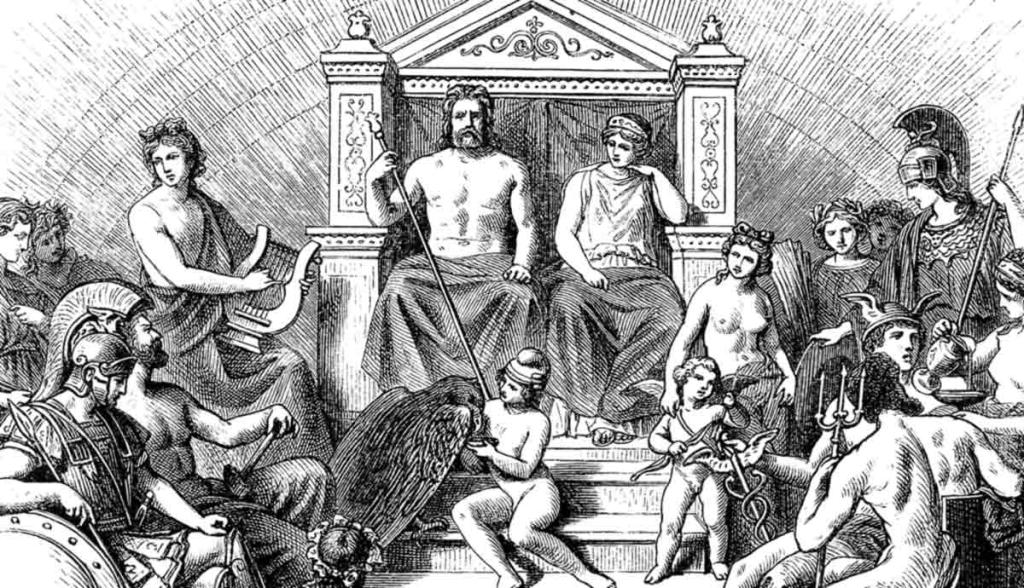
So the gods, and the men who have dared to take on their characteristics, are many-wayed. And this is why Odysseus is hated; he is cursed because his mode of being, and the essence (i.e., the what he has become) directing it, has violated the ancient code that mankind is not to partake of the realm of the gods. Odysseus has committed the Promethean sin, but rather than be chained to a rock, he is now tossed about from place to place, from centre to centre; home-less even if he had a place to call home. Telemachus and Penelope — Odysseus’ faithful wife and loyal son — are the human ones who maintain a home for him; who hold the image of his identity and personhood within and before. Odysseus is no longer human (i.e., limited) enough to be capable of holding onto home; if the gods have their way, he will no longer be permitted to do so. Odysseus is now caught between heaven and earth. He is an Actor — continually transforming and being transformed; he is a hypokrites who wears the mask of the gods.
Now Christ steps into this world: a world in which the pagan gods are seen as inherently duplicitous, cunning, even capricious. Even if God is all-Good and One, as the Jews claimed, then His ways are inscrutable to both human cognition and the human senses. What appears as brokenness, evil and injustice to our human eyes, is not and/or may not be seen as such in God’s sight and within God’s economy: “For my thoughts are not your thoughts; your ways are not my ways” (Isaiah 55: 8-9).
The Second Jewish Temple understanding of the good human being is the human being who walks righteously: this human being is the one who follows God’s Law, who remains upright and stays within the place given to him/her by God; he/she is the one who is faithful to this place, like Job, even in the face of God’s (seeming) arbitrariness; the one who submits to God’s Justice (even if he/she does on occasion, in an effort to hold God to His promises, argue with Him). The Hebrews wandered — like Abraham — but they remain centred in God. That is what it meant to walk in the Way (Hebrew, derek) of Righteousness.
But, although this Way of Righteousness was certainly its foundation, this was not The Way of which Christ was speaking, and of which He claimed to be Himself the embodiment.
Christ understands the many-wayed to now be the way of all men. By the coming of His (the Piscean) age, all men lived between heaven and earth; all men had strayed; all men were sinners. “Let him who is without sin cast the first stone” (John 8:7). All humanity now lived in a no-man’s land in and through which he was tossed to and fro (mala pola); in which man was too many-turned (polutropon) to find his way back to an earthly home.
Christ’s recognition of humanity’s collective state of ‘lostness’ and of moral ambiguity can be heard in his Parable of the Dishonest Manager (Luke 16): “And the Lord commended the unjust steward, because he had done wisely; for the children of this world are in their generation wiser than the children of light” (Luke 16:8). This passage has often perplexed faithful Christians: how can the manipulative liar and the cheat be wiser than those who submit and passively carry the light of God? What actions can be called right or wrong in a world in which “everyone is forcing their way into [the Kingdom of Heaven]” (Luke 16:16), scheming their way into the realm of the gods? Christ affirms: the Divine Law (an eternal reality) will be upheld — “not one jot or tittle shall escape from the Law until all be fulfilled” (Matthew 5:18) — but how this following of the Law will manifest itself in outward human behaviours cannot be easily prescribed without making it into a stumbling block — without turning it into the means by which men, through innate violence, self-centredness and trickery, become, and compound their state of being, strayers and sinners?
Christ cuts through the Gordion knot of the conundrum: through the Mystery of His Fully Divine & Fully Human Being, He stabilizes and internalizes the Law so that is now written upon Humanity’s heart. Christ says, “I Am. I am not many-wayed (like the false gods you have placed before me). I Am The Way. I Am here in the maze of your own heart. I live, as the Life and the Truth, at the centre of your hearts’ twists and turns — a moving still-point, a centre, a place of belonging. I lead you along The Way to that centre; I Am in that centre, and I Am that centre. I Am Christ in you.” He then goes on, in this Imagination, to say, “Use your resourcefulness/your many-wayedness — your lost in-between condition of being — to keep seeking this centre into which I will pour Myself out continually and through which I, in Love, draw you toward My Life-Light and Flame.”
“Repent! Recognize your lostness, your many-wayedness! Own and perceive what you have done! Receive the Love of God. Turn around and come onto The Way!”
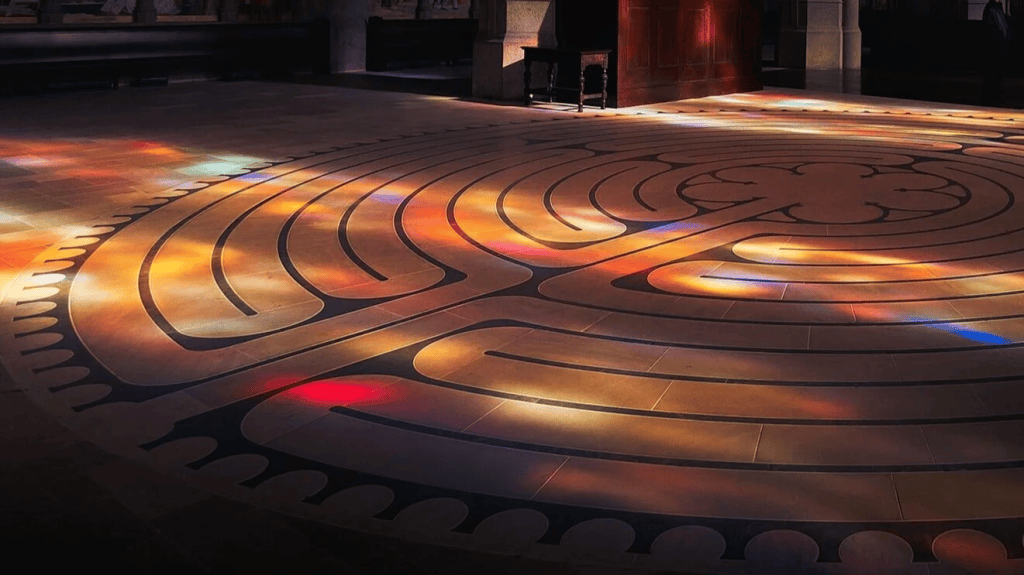
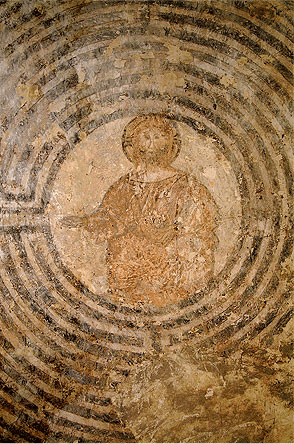
The Presence and Reality of Christ, as Son of God and Son of Man, transforms the maze of the human heart into a labyrinth.
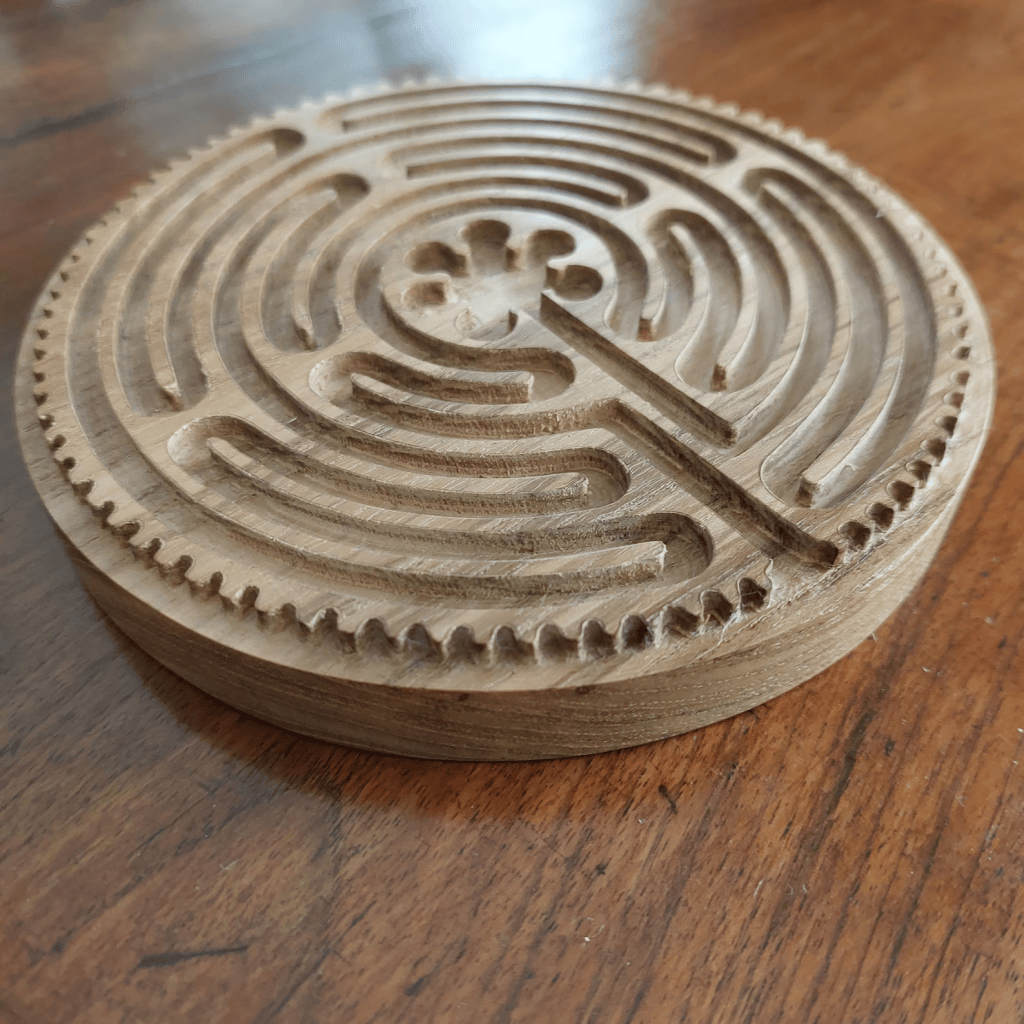
A labyrinth is not a maze. There is but one path — The Path — to its centre. Christ is the thread of Ariadne that pulls humanity’s condemned Theseus along the turns to the resting-place at the core of its geometry. Christ is Ariadne, the Giver of the Thread; and He is the centre to which the Thread is anchored. He is the faithful Penelope and loving Telemachus who hold and offer us our Highest Self; our true identity in Creation which had become almost irretrievably confused and lost through our wandering. He is The Way: 1) The Way to our full Humanity; The Way to the retrieval of our imago dei, the Divine Image of the Human Being and 2) a renewed Way of Righteousness; a theosis, a uniting with and becoming like God through God’s grace.
In this early Church understanding of the The Way, we discover, in union with Christ, the Truth and the Life:
“For if anyone is in Christ, he is a new creation; old things have passed away; behold all things have become new.” 2 Corinthians 5:17
“For it is no longer I who live, but Christ in me.” Galatians 2:20
It is hardly surprising that the early followers of Christ — Gentile and Jew — called their path of discipleship ‘The Way’. Through the use of this one name, the community addresses the suffering and ‘lostness’ of both the Hebrew and Greek worlds. Is this still the case today?

