The content reflects on the significance of the Feast of Corpus Christi within Christian theology, highlighting the Eucharist as a transformative bridge linking humanity with God and creation. It emphasizes the necessity of healing and unity, addressing the wounds of division, death, and identity loss caused by the Fall. Several Orthodox theologians contribute insights on Eucharistic theology, portraying the Eucharist not merely as a ritual but as a means for salvation and wholeness. Ultimately, it stresses communion with the Divine and the ongoing movement towards God’s redemptive love through active participation in the Church.
“For my flesh is true food, and my blood is true drink. Whoever feeds on my flesh and drinks my blood abides in me, and I in him. As the living Father sent me, and I live because of the Father, so whoever feeds on me, he also will live because of me. This is the bread that came down from heaven, not like the bread the fathers ate, and died. Whoever feeds on this bread will live forever.” John 6: 55-58
Corpus Christi....
The Great Festival of the Reordering of Time, Space and Being...
The Vanquishment of Evil and Death...
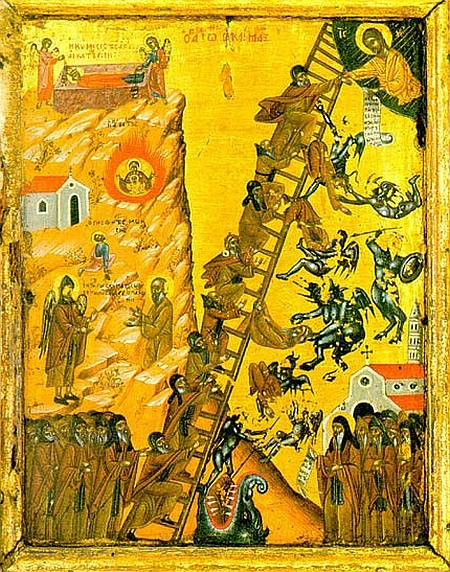
The Magnificent Eucharist (Thanksgiving) of the Bridge -- the Ladder -- Between God, Humanity and All Creation ...
The Ushering in of God's New Spiritual Order to Redeem All Matter..

The Eucharist is the Great Mystery:  language alone cannot do it justice.
Therefore, this blog will be smattered with musical remembrances of the Great Feast of Corpus Christi -- these selections here from pre-Reformation England:

https://www.youtube.com/watch?v=NZzfI9-QElU

https://www.youtube.com/watch?v=RfvEef_vAeA

I was to share with you today the continuation of my four-part blog on Christ, The True Vine.  But these are the days leading up to the Great Feast of Corpus Christi in the Roman Catholic Church -- a day to commemorate all wonder, grace and redemption.  This is the Day to celebrate the True Vine:  the revealing of His economy, His order, His Great Love.  (So I will put the remaining two parts of my blog on hold for a few more weeks.).

Today, we are going to go forward in time.  Normally, my blog mostly concerns images from the first centuries of Christianity:  providing exposition of them and then considering how they might yet be living and breathing in our day.  In this blog entry, I am sharing with you a reflection upon Eucharistic theology, mostly as revealed through Orthodox theologians of the past 1000 years -- from tenth-century Nicolas Cabasilas to twenieth-twentyfirst century John Zizoulas.

In the West, our language about these mysteries has become dulled.  These voices from the Eastern Church They reveal a powerful living picture of God's Action and Grace in our very midst.

The Feast of Corpus Christi celebrates the Eucharist's significance in Christian theology, emphasizing salvation and unity through Christ. The Feast highlights the transformative power of the Eucharist in reconciling humanity with God, addressing the wounds of division and death, and offering wholeness and healing for creation.  The Eucharist remains a mystery:  attempts to submit it to discursive logic, reasoning and philosophy have failed.

Christianity is redemptive and therapeutic; not merely palliative, not merely 'getting through this life'.  Christ promised us abundance of joy, abundance of life (John 10:10).  Christ is the Great Physician Who heals all our wounds:  this healing is yet offered today -- through prayer, through encounter, and, pre-eminently, through the Eucharist.  Through his wounds -- His Blood and His Body -- we are healed of our wounds of Division, Loss of True Identity and Death.

There is no other therapy that comes close to what Our Lord -- the Great Son of Man -- has done and continues to do for us.

(This blog is unapologetic about using the name Man to refer to Humanity as a whole:  in this way, the connection between Christ, The Son of Man, and redeemed Humanity, the sons of the Son of Man, becomes clear.)
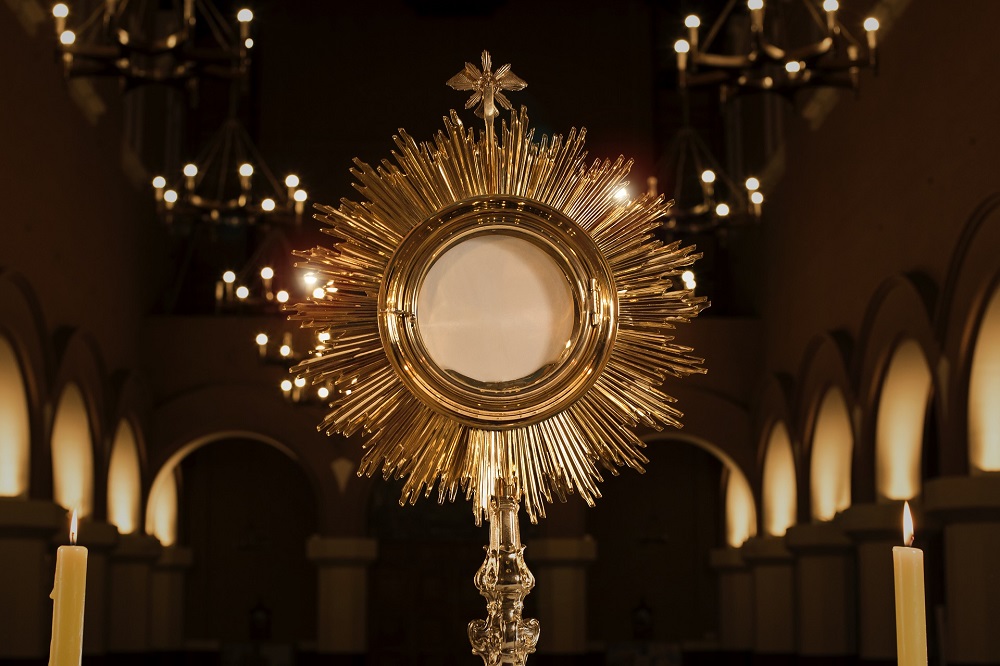
The Salvific Operations of Christ in the Eucharist:
A Reflection on Orthodox Sacramental Theology
Christ: Our Body and Blood; The Eucharist: Offering us Life in God
Wound: Division; Remedy: Unity; Means: Eucharistic Descent; Icon of Unity: Transfigurement of Matter Wound: Loss of Identity; Remedy: Participation in Holiness; Means: Eucharistic Ascent; Icon of Holiness: CommunionWound: Death; Remedy: Wholeness; Means: The Son of Man in the Eucharist; Icon of Wholeness: Remembrance of the Future
God seeks the salvation of men and sent His Only-Begotten Son to become our Lord and King that we might be saved from sin and the wounds of Man’s/Adam’s Fall.
The Kingdom of God came among us of God’s Creation with the first moments of the Incarnation. The plan of God, through life-death-and-resurrection of Christ, was to ensure that this Kingdom, while not of this world, could be entered into through the actions and experiences of earthly man’s life. Accordingly, Christ appointed a Kingdom for us which is His Church. This Holy church presents an image and icon of God.[1] (Max, 65) It is in and through the ikona of this Church that man receives the healing and the righteousness which he requires in order to participate in the Kingdom. “As my Father appointed a Kingdom for me, so do I appoint one for you that you may eat and drink at my table in my Kingdom” (Luke 22:29-30).
The symbols of the Church “grant us the original archetypal mysteries of Christ’s Incarnation/Salvation represented to the senses” (Max, 104). Thus it is in the experience of ecclesial symbols, in communion with Christ and the Holy Spirit, that man partakes of the salvific operations of God. Each mysterion of the Church forms man for the Kingdom, but the formative mystery par excellence is the Eucharist. As St. Maximos the Confessor writes in his Mystagogia, “The Eucharist brings about resemblance in Him, which effects communion and identity with Him by participation after which the human person is fit to be changed out of a man into God” (Max, 104).
In the lineage of St. Maximos the Confessor, several Orthodox theologians have explored the implications of the Eucharist’s symbols for man’s salvation. These writers include Nicholas Cabasilas, Alexander Schmemann, Dumitru Staniloae, Panayiotis Nellas and John Zizioulas. Their work reveals a readily-accessible act of Christ in the Church which is central to the salvation of man.
The Eucharist as generous continual opportunity to come into relationship and conformity with the Spirit of God (Ziziou,109), drawing upon, and at the same time satiating, mankind’s hunger and thirst for the fullness of God (Schm,116).
The Eucharist as Salvation is characterized by two symbolic movements: the descent of the energies of the Trinity and the ascent of man. In the descent, matter and mankind’s garments of skin are redeemed. In the ascent, the divine image in man and his priestly vocation is reclaimed. The first brings about union; the second allows men to participate in holiness. Between these two movements a third reality emerges which is the healing and wholeness of man, and all of Creation by extension, as it will be in the eschaton. This last reality acts as a gatherer of all creatures into the Body of Christ.
In this communion, which is Church (with its marks), mankind’s identity as New Adam and Person (the son of the Son of Man) is effected – that we might become the righteousness of God.
1. Unity in Christ: The Redemption of Flesh
The Wound: Division
The Fall of Man brought division into the Creation. St. Maximos the Confessor identified five areas of division that characterize our post-Lapsarian reality: 1) the division between created and uncreated nature, 2) the division of created nature into the sensible and the intelligible, 3) the division of the sensible into heaven and earth, 4) the division of earth into paradise and the inhabited world and 5) the division of man himself into male and female. These divisions lead to strife between the creatures of Creation. That strife, in turn, gives rise to conflict onto death. Man against Creation; Creation against Creation; Man against Man.
This conflict manifests in many of the garments of skin which Adam received upon his Fall – perhaps most centrally in one in which man must partake in order to survive – eating. Upon his expulsion from the Garden of Eden, man is told of the food to eat which he must earn by the sweat of his brow (Gen. 3: 19). In most cases, the very act of eating means the suffering of another life-form. The damage of this is felt across the entirety of Creation: either one consumes or is consumed. The fear which this physiological need brings about in man’s mind reinforces and feeds the conflict, strife and division which he sees in the world about him: man perceives the struggle for survival everywhere. The Fear becomes ubiquitous as every human being must eat in order to live. This mind-set, often divorced from actual physical need, takes hold of individuals and of human society – entire civilizations are built upon securing food and water over and against others.
The consequence of man’s mental-fixation upon bodily needs feeds his self-love (philautia). One’s life becomes a story of ‘me-against-the-world’. The blameless passions of hunger and thirst become linked to all manner of vices and sin – although gluttony is the most obvious of these, other sins of malice, avarice, envy, pride and anger can all be traced back to man’s primordial attachment to satiety and his fear of its loss.[2] Through philautia, rancor an division grow. St. Maximus the Confessor knew this well: “The self love and cleverness of men, alienating them from each other and perverting the law, have cut our single human nature into many fragments.”
This state of sin, fueled by self-love, is known as ‘flesh’. It is a state of being as well as a self-reinforcing and engulfing cycle that cannot escape itself: “He that soweth to his flesh shall of the flesh reap corruption.” (Max, 86) Mankind is born into flesh and he lives through flesh, feeing upon it. As a result, he ‘survives’ instead of living.
Man was intended to be the anchor/ the steward of Creation. His brand of survival is also burned, both perceptibly and imperceptibly, into an enslaved Creation. All of created matter is marked with ‘flesh’, which, in the created order, is known as ‘materiality’. Since the relationship with the human body, and therefore, with the soul and with God, has been overturned, matter has become enclosed within itself; its movement has become blind and futile. Materiality is that state in which matter is characterized exclusively by its own elements, in which it is deprived of its development or movement towards spirit. Within the fall there thus exists a fall also of matter itself (Nellas, 86).
If the cycle of flesh is to be broken, both man and matter are in need of healing. This healing will be effected when men become children of God instead of children of flesh and blood (Nellas, 82).
The Remedy: Unity
If the wound at foundation of ‘flesh’ is division, then healing is to be found in unity. It is Christ who offers unity. He does so on three levels: 1) through His unity with the Father of All, 2) through His presence and action as the Logos who is the effector of unity in Creation (Max, 65), and 3) through the perpetual offer and sacrifice of His one Body to the world as Church, the Body of Christ. “That all of them may be one, Father, just as you are in me and I am in you. May they also be in us so that the world may believe that you have sent me” (Jn 17:21): with this prayer offered at His Last Supper with His disciples, the Lord Jesus Christ expresses these three levels of unity.
There is not much we, as humans, can say about the nature of Christ’s unity with the Father. This unity is of the Trinity’s essence. As for the second level of unity, St. Maximos affirms that Christ “keeps a firm hold on all things by the sheer infinitely wise force of goodness […}; by one single force He does not permit the element of things to break their bounds, but contains their impulses and draws toward Himself the varieties of beings He has made, so that the creatures of the one God will not be wholly foreign or hostile to each other.” (Max, 67) To accomplish this, the Logos not only draws together, but also circumcises – it cuts away that which is not of the spirit and of unity.
The unifying action and the unity of the Logos is apprehended through Wisdom – which St. Maximos describes as radiant, simple, compact and complete — conferred as illumination by the Holy Spirit. It is unifying Wisdom and its patterns — not division, struggle or competition — which is the fundamental template and medium of the matter of Creation. This is the Truth of God in Creation and, in revealing this Truth, Wisdom is the Life in and of the Mind (Max, 73)
At first, true Wisdom, in its awesome completeness, brings a different type of fear to man – not a fear based in survival, but in the fear of God. It is this transfiguration of fear which permits man to enter into contemplation of God. This contemplation of God leads to Knowledge and Unforgetting Knowledge. Knowledge, in the Patristic sense, is not a catalogue of discrete facts; rather, it is to be within the other.
This Knowledge of God, carrying Wisdom, restores man’s Mind to unity – The wound between his thinking and his perception, which has permitted his entire psycho-somatic unity to be captured by survival’s myth of division, strife and conflict – is healed.
How does man receive of this healing unity?: the Eucharistic Descent
The reception of this gift of unity occurs through a Eucharistic movement of descent. God’s energies descend from the heavens to the earth: He descends upon and through the matter of Creation; He descends from the sanctuary of the church upon the people and the elements entering through the nave. All these descending movements echo the actions of the Incarnation, i.e., the Christ’s assumption of human nature into His one Person — His Birth, His Life, His Death. They are the descent of Christ the King as He becomes slave to all in his ongoing self-emptying sacrifice. They are a revealing of Divine Love.
The descending energies of God transform and transfigure flesh. They do so by descending into the very depths of matter and materiality. In so doing, they take the brand of man’s survival – the garments of skin of eating and of earthly food which he has worn since the fall – and convert it into the Wisdom which gives Life.
The Icon of Unity in the Church: the transfigurement of matter
The Holy Spirit, in union with Christ and the Father, imbues Life into the fetters of man’s bondage to matter. How this occurs is a mystery: we cannot speculate as to how it happens. What we can speak of is the perceptible means and the effects of this action. It is energy of the garments of skin which carries the work of redemption. It is the garment of skin of eating which, transformed, leads man to receive unity from the Trinity in the holy meal of the Eucharist. Thus God takes the wounds of our fallen nature and turns them to the service of His Kingdom. He does so, as He did upon the Cross and in His Incarnation, by taking the wounds, the division and the sin of our nature upon Himself.[3] “Christ dwells in the inner state of our nature, offering for us the sacrifice of Himself as High Priest to the heavenly Father.” (Stan, 138)
The word for Bread in Hebrew is lechem. This is also the word for flesh and for fruit. Bread is the work of our flesh earned through the sweat of our brow – a fruit of division, a garment of skin which God now makes true Food for our redemption[4]. Wine, also earned through the sweat of our brow, is an instrument of forgetting which God now transforms into Blood for the joyful healing of our will.[5] The descent of God’s energies, effects two movements of transformation: 1) they throw forward (metabole) material bread and wine into the Kingdom and metabolize them into what they were intended to be, and 2) they transform them into the Body and Blood of Christ, i.e., the Flesh of Christ. The first transformation addresses the Lapsarian wound — that matter has become misaligned and separated from Spirit: in the Eucharist, God unites/aligns spirit with matter once again. The second transformation reveals the depths of God’s Love – that God’s Only Begotten Son, the Logos, has sacrificed Himself to effect unity by His descent into matter to become Food for His adopted children who had once been the slaves of His enemy. Christ becomes artos epiousias – “the bread in excess of subsistence.” (Zizioulas, 27)
The Church does God’s work in us (Max, 66). By partaking of redeemed Matter (the Body of Christ), our very material nature is also changed. It becomes as Christ. We are incorporated into His Flesh — into His Body and His Blood. The Christ which we receive, as Logos, is actualization of all unity in the cosmos. Man now feeds upon unity and, in his redeemed flesh, a source of unity. He now lives in Christ and receives the unity needed to heal his mind and, thus, his body (psychosomatic unity).
The illusion of the world’s understanding of survival is revealed. Cabasilas relates: “Since natural food is not itself living it does not of itself infuse life into us, but by aiding the life which is in the body it appears to those who eat it to be the cause of life. But the Bread of Life is Himself living, and through Him those to whom He imparts Himself truly live. While natural food is changed into him who feeds on it, and fish and bread and any other kind of food become human blood, here it is exactly the opposite. The Bread of Life Himself changes him who feeds on Him and transforms and assimilates him into Himself.” (Cab, 125-26) It is all of man’s senses and bodily functions as well as his mind which are purified. Here the principles of sacramental realism need to be applied in order to fully experience and apprehend the import of this salvific event.
In his act of consumption, man is now consumed. But the very act of consuming is also transformed. Natural eating, based in division and survival, results in all distinctions between the matter of the eater and the eaten being obliterated. In the Divine Banquet, the consuming of man does not lead to his annihilation but rather to this fulfillment. “It is God’s nature to work this unity Himself in the substance of things without fusing them.” (68, Max)
In all these transformations, the reality of the Wisdom of God is revealed and experienced: “The manifold quality of wisdom which arose from a union of opposites is now clearly manifested through the Church: the Word becomes flesh, life is mixed with death […] he becomes a slave and yet remains a king. All these and similar examples are manifold works of wisdom.” (St. Gregory of Nyssa, cited in Stan, 130-31) As participants and recipients of God’s grace, we readily contrast the flesh that momentarily feeds with the Wisdom that gives Life.
2. Participation In Holiness: The Restoration of the Divine Image
The Wound: The Covering of the Divine Image in Man
Man forgot his divine vocation to offer up to God the beings of Creation, and chose to follow Satan instead. Satan accomplished his goal by causing man to doubt the goodness of God. His plan was to deceive Adam and Eve into the belief that God did not care for and love them. If not for the grace of God, this choice would have led man to become a purely material entity, caught in the web of matter and speedy death. As it was, the garments of skin given to him by God enabled man to live – albeit as a mortal — in the hostile world which his fall into sin engendered.
Instead of being Priest of Creation, man took on the identity of Consumer. His fall into the snares of eating and Food have been outlined in Theme 1 of this paper. This fall led not only to enslavement of matter, they also led to a loss of man’s identity – his divinely-ordered role in Creation. Man became pre-occupied with the pursuit of survival, and in so doing, he took on a myriad of identities: some of these identities bore partial resemblance to his original divine vocation; others were very far from the mark. Whether naming himself saint or sinner (righteous or unrighteous), man fell into a state of confusion. Thus man’s use of Creation also became disordered. Instead of treating the world as sacred gift to be named and offered back to God, man now viewed Creation as raw material to be exploited. (Zizioulas, 141) The true value of Creation was lost; its Reason was betrayed and, with it, man’s reason was also dissipated.
Man’s will – the drive within His actions – also became unreasonable; it became a gnomic will, no longer free in God, but enslaved in the passions bent upon the seeking of pleasure or the avoidance of pain. Splintered and fragmented, tossed to and fro by his sympathies and antipathies, man no longer could serve freely as a light within Creation but instead became a source of darkness and division.
The light in and of man, which is the image of God in him, became hidden, occluded by the distracting vagaries of the passions. Man lost sight of the divine image within; and instead came to believe in the false identities suggested to him by the passions. He doubted in the possibility of his goodness, and true to the original ploy of Satan, his doubts about the Goodness of God also multiplied. Man became indiscreet and impulsive — a chaser of experiences. He sought beauty; but he was also stricken with sorrow in that he knew this beauty could not really be of this world. (Schm, ) This did not, however, stop man from thirsting for beauty and many fell into a state of sin attempting to preserve it for themselves. The image remained in man, true to the promises of God and His pronouncements on the goodness of Creation, but it was not readily perceptible or known by man and the Creation.
The Remedy: Participation in Holiness
If the wounding occurred by the obscuring of the image of God, then the remedy lies in the reclamation of that image, both existentially and in the consciousness of man. It would involve the restoration of man’s sacred vocation – for him to intentionally become a priest of creation instead of a consumer. This vocation is man’s pre-Lapsarian identity: as Nellas outlines, in sharing these words from the Great Canon, “the human constitution is the tabernacle fashioned by God, the first robe that the Creator wove for me in the beginning, the beauty of the image, the beauty which was first created, the first fruits of original beauty” (Nellas, 173-74). Mankind was made to participate fully in holiness of God: to shine forth His image and to grow in his likeness.
In the post-Lapsarian world, one senses holiness in those realities or in those persons who seem set apart from the ways of the world – in those who follow God’s laws Whose ways are now so very different from our ways. In the Old Covenant of the People of Israel, God’s holiness could only interact with the Creation in spaces and times set apart, such as the Holy Mountain upon which Moses received the Commandments. It was man’s duty to obey these commandments: in faithfully obeying these commands, in observing these set festivals, he would be able to participate in the holiness of God once again; he would be declared righteous/upright. Such was man’s labour in and for God.
Unfortunately, the gulf between God and man was such that no man could ever claim to be fully righteous. Holiness remained largely unattainable and of things set apart[6]: It was to overcome this gulf that the Christ became man. Christ, living in us, under the guidance of the Holy Spirit, now becomes the power in us to defeat sin, and to overcome the irrational life in and of the passions. He uses our sin, our garments of skin and our recognition of ourselves (our identity) as sinners to help us overcome sin.
One of man’s ‘garments of skin’ is his mutability: ruled by the passions, man is in a constant state of flux. The benefit of this, however, is that he never remains the same. “We are to use our mutability as an ally in our ascent toward higher things, and by the changeability of our nature we are to establish it immovably in the good.” (Stan, 130) Christ is able to harness this changeable nature to facilitate our progress toward the Divine Image in us and the reclamation of our vocation. Cognition of our mutability also gives man the necessary prudence, contrition and humility to let go of the false-identities with which has made him a law onto himself.
Man participates in the Holiness of God when he chooses to live his life totally onto God – surrendering all that makes him distinct and autonomous from the Christ. It is through the grace of the Holy Spirit operating in this necessary surrender, in which man seeks the grace to resemble Christ, grow in His likeness and to express His virtues, that man reclaims his Reason. The very action of surrender – of sacrifice and of offering — makes him a priest of creation once more. Thus is the Divine Image in man uncovered for the bene
How does man participate in this holiness?: the Eucharistic ascent.
It is not through simple knowledge of God[7], but through work, that man participates in holiness and becomes righteous (St. Mark the Ascetic, cited in Stan, 127). Man’s will – his ability to organize his actions toward a goal – was wounded and became disorderd by the Fall. The remedy for this must include the activation and realignment of the will, i.e., it must involve action. The man who seeks righteousness must industriously push forward (epektasis) into Christ. St. Maximos speaks of a progression from Prudence to Action to Faith and to Virtue.[8] Each of the elements of this movement are significant – what is common to all is man’s active participation and his goal of acquiring the virtues (i.e., righteousness) in Christ.
The path of the Virtues is an active one which mirrors the sacrificial path that Christ trod as He descended into the raising of His human nature. But the path is fraught with challenge and danger: man walks a razor’s edge between over-passivity and over-activity. No one can acquire Christ’s virtues without the aid of Christ. If one attempts to become virtuous through one’s own efforts alone i.e., autonomously, he will fail and fall into pride and self-delusion (prelest). We must be accompanied by Christ and Christ does this as He knows, from His raising of His human nature, the stages of virtue-acquisition. It is Christ who passes “from stage to stage with us so that as man He might ascend together with us in infinitude of the Godhead by which His humanity was assumed.” (Stan, 132)
Man’s growing participation in holiness cannot be undertaken outside the Body of Christ, the Church. All mysteria (sacraments) are all vital to the recovery of man’s priestly vocation and the healing of his will. “The will, which at baptism was detached from temptation toward sliding, died to sin with Christ and rose with Him to new life. But this mortification of sin and toward new life must continue through the power of Christ’s death, and of His life, through progress in holiness.“ (Stan, 136) One meets the power of Christ’s death and of His life most fully in the Eucharist. Accordingly, it is the mystery of the Eucharist which most substantially facilitates epektasis.
While Christ’s path through the virtues as the Incarnation was a descent ending with Humility which enabled the raising of His assumed human nature[9], man’s is an ascent which begins with Humility. Man offers the sacrifice of Himself, allowing it to ascend up from the nave[10] toward the Eucharistic offering transformed into the Body and Blood of Christ. Man offers himself in love to the God Who has revealed His Great Love for him.
The ascent of man is the Way of the Cross – a dying to self-love (philautia). Man burns away his self-concern and seeks only to become united in body and in action with his Lord. As such, man becomes the bearer of Christ. Man comes to know himself as person in Christ – no longer as an autonomous individual. With this recognition it becomes possible for man to view himself in his primordial Goodness (and God saw that His Creation was good); to come to an awareness that the Image of God in him is not lost and that God has not forsaken him.
Most emphatically, the eucharistic ascent means the recovery of man’s knowledge of the Goodness of God – the loss of which had enabled the serpent to tempt Adam. In this reality lies a fundamental affirmation of Faith — of man’s fundamental Resemblance to God and of God’s abiding – never-failing — Communion with him. Man takes up his priestly vocation in the recognition that He is a priest in Christ (not a consumer) and that this is not a mere intellectual statement of identity but an existential fact. In the Eucharist, man’s ascent is his action/works as a priest in the Image of God.
The Icon of Holiness in the Church: Communion
“I appeal to you, brethren, by the mercies of God, to present your bodies as a living sacrifice, holy and acceptable to God, your spiritual worship.” (Rom 12:1) Man makes his sacrifice in and through the power of Christ given to him through the Bread-Body and the Wine-Blood. “Christ discreetly strengthens us through the gift of His Holy Food[11], so that we may add the sacrifice of our nature to His sacrifice and may renounce ourselves in order to enter into dialogue with the Father through Him.” (Stan, 138) The Body brings spirit into matter; the Blood transforms our instincts and cleanses our will. It is Christ, Body and Blood, in and through the Holy Spirit, who initiates and enables man’s eucharistic sacrifice. The Eucharistic table “enables us to use the power and the weapons which have been given to us to pursue Goodness.” (Cab, 131) The Church Fathers clearly understood that this is a fight which requires strength: it is a battle for the soul of man and, by extension, the Creation.
Man’s active eucharistic offerings take a variety of forms: 1) the offering of the work of his hands in material form (i.e., the bread and wine), 2) the contrite heart, and 3) the offering of his victories over sin. All entail the challenge of surrendering completely to God in the likeness of Christ. The gnomic will’s hold upon human energies is released and Christ’s complete surrender in love onto God. “St. Maximos sees the meaning of the Holy Eucharist in the imposition of the will upon nature, in the total control of the will that is determined toward good to such a degree that is would renounce even life itself rather than accept the pleasures and compromises of sin.” (Stan, 136) Man’s true will is a rational priestly will which seeks nature’s true interest (Stan, 136).
The offerings of bread and wine themselves are an expression of man’s overcoming of sin: they are Food, marked by the Fall, which man might wish to keep for himself and his own survival. This Food is given over to the Body of Christ, the Church, in order that it might be transformed, for the good of all, into the Body and Blood of Christ. It is an act of selflessness: man rescinds whatever claim he may have upon these gifts, renouncing his own self-love. The gifts are holy and receive censing even before their transformation into the body and blood Christ (Schm, 118).
Through contrition, man makes an offering of his own flesh by, as with the Prodigal Son, “coming to himself”. “With fresh eyes the believer sees the real depth of sin” (Nellas, 182) and is cut to the heart. This is the first act of salvation and the point of departure (Nellas, 183). Man offers this pierced heart up to God. The tears he sheds enable the washing of his garments of skin. “Blessed are those who wash their robes, so that they might have right to the Tree of Life.” (Rev 22:14)
Man’s victories over sin are offered to unite with Christ’s victory over death in the Bread-Body and Wine-Blood of the Eucharist. They are the crucifixion in self and a living sign of the Image’s active presence in man and the reclamation of man’s Reason. They indicate man’s triumph over biological being and the restoration of the primacy of his theological being. (Nellas, 175) They are the acquiring of the robe of the heavenly banquet.
All these gifts are an icon of Christ and His holiness expressed in and through the Church. The prayer of offering in the Divine Liturgy expresses this, “Thine own of Thine own we offer onto Thee, on behalf of all and for all.” (Schm, 211) They are a communion of man’s works with the works of God. We are not capable of imitating Christ: it is only our incorporation of our works into His work – our being knitted into His Body – that brings forth our righteousness.
Although it is Christ Who activates the ascent, human activity is still of prime importance in the manifestation of the icon of holiness. There must be no delay of the human works and effort. Cabasilas writes, “We must feed on our Bread ‘in the sweat of the face’ (Gen 3:19) since it is ‘broken for us’ (1 Cor 11:24) for it is appointed for those who are endowed with reason. It is the Lord who says, ‘Labour for the food which endures.’ (Jn 6:27) He commands us not to be idle and inactive, but to come to His banquet as those who are working.” (Cab, 132) He commands us to become persons in Christ, and not remain as immature individuals.
Man’s offering of self is really Christ in Him – and reveals a communion between man and God which makes possible the reordering of Creation with mankind as priest. “Through this the human subject becomes fully open to other subjects, in the same way that Christ, whose human nature is found in the hypostasis of the Word, is fully open to other human persons not only as God but as man. This makes Christ transparent through human nature, and more precisely through the person bearing his nature.” (Stan, 137) With the acquisition of the virtues, man’s senses become consistently spiritual. He is now able to perceive the world aright and thus become, through the power of Christ, an agent of her liberation.
3. Wholeness of Persons: The Healing of the World and of Time
The Wound: Death
“The wages of sin is death.”(Rom 6:23) Through his Fall, man turned away from God and the Tree of Life was lost to him. Without the eternally-flowing and life-giving fountain of God’s full presence, mankind was reduced to a biological existence in which decay, entropy, change and loss are inevitable. All of these realities lead onto death – an extinguishing of biological life and return of man and all Creation to his constituent elements. Death is the weapon of the Great Enemy. In our day, we have sentimentalized death and made it solely about our emotional and individual losses. This is an aspect of Death’s cruelty, but it is not the primary one: fundamentally, death was intended by Satan to be a sign of the absence of spirit in matter; the triumph of the Devil’s plan to alienate man from God and turn his rival mankind into dust.
The mark of death pulled Creation into the fabric of what we now recognize as Time (but which is actually a distortion of Time). This is a broken Time which only knows the past and the present and which cannot name the future. Hope in the future is vague; fear of the future drives the material passions of man. Recollection of the past is marked by sadness and regret; the loss of things that once were. The present is often either lost to the regrets of the past or the avoidance of fears and/or the acquisition of the partial hopes of the future. Time pushes man into the avoidance of pain and the craving for pleasure. Man’s mind knows these experiences are provisional and bound for decay, and yet he still pursues them, thus fueling the passions which perpetuate and inform his state of sin.
Man falls deeper into sin in his attempts to preserve his life, his own well-being and which give him a sense of security and meaning about his past. Many of the strategies he uses appear noble: they are culture, they are society, they are rite, legacy and ritual. Sin is not merely pernicious acts. Sin is a state of being, of which Death is both sign and source. The problem is an ontological one.
The Remedy: Fullness of Life (Wholeness)
“But the gift of God is eternal life through Jesus Christ our Lord.” (Rom 6:23) So often, the remedy for Death has been the hope of some future immortality – a heaven beyond this world. This remedy, as comforting as it has been for some, is still bound by the hermeneutic of Time. Its claims of timelessness and /or eternity are an expression of a negation of Time – as Time eradicated or overcome. But Time is a creation of God and, like all Creation, damaged and marred by the Fall. What would a redeemed or fulfillment of Time look like?
Fallen Time destroys relationship: it tears things apart; it ruptures connection leading to grief and sorrow. Redeemed Time would take the energies of fallen Time and turn them inside-out. Redeemed Time would facilitate the restoration of intimate connection, fullness of relationship and the recovery of joy. In redeemed Time, one would experience fullness of Life – Death would be no more.
This language to described redeemed Time reminds us of the Parousia of John the Divine’s Apocalypse. The Greek word parousia means kingdom, but it also means presence; an apocalypse is a revelation or uncovering – a removal of darkness, a bringing of light. Thus the redemption of Time is connected to the Revelation of the Presence of God – the presence which is and has always been there, but which awaits fulfillment i.e., our recognition of and cooperation with its revealing. Death, and the resultant wounded conception of Time, prevents us from perceiving the Presence and thus in cooperating in Its revelation.
We would be and are equipped to reveal the Presence in and through our own reclamation of Life. But how is this Life to be recovered and received? It is through Christ alone that this would be and is possible. It was He, as Logos, who gave Life to everything in Creation. (Jn 1:4) It was His Life, as Second Person of the Trinity, Who brought Light to everything created. (Jn 1:4) And with His Incarnation and descent into matter, Christ’s mark of Life has been imprinted upon all Creation. Victory over Death has been accomplished in Him. It is no longer a point of debate. How are we seize this victory and thus cooperate in the Revelation of God’s full presence?
It helps us to have an intimation of that fullness of Life toward which we are headed, but which is also ours in the present. Although beyond the scope of imagery to describe the fullness of the Presence, certain images (symbols) are helpful to humanity. One of these is of that of the Wedding Banquet or Marriage Supper. There will be rich meats and fine foods for all; there will be much rejoicing and the wiping of tears from every eye; there will be the promise of the union of what is divided into one. This feast was promised by the Hebrew prophets of old who saw in Time the advent and hope of something better: a future in which the lion would lie down with the lamb. John the Theologian saw this Kindgom as a present reality awaiting fulfillment. Here was no mere absence of violence, but a positive victory over division and death – the restoration of God’s full Law. Here was the wholeness (kata physin) and healing of Creation, now a carrier of the fullness of Life. Here all the creatures of Creation sit about the table in communion with one another – in the profound awareness of one another — with the One at the centre upon the Throne who has brought them to union with one another. This Life would be a life of wholeness, plenitude and connection.
How can Man experience this wholeness? The Son of Man in the Eucharist
If man is unable to effect virtue in his life, then he most certainly is not capable of changing the nature of Time and defeating Death. But there is good news: the fullness of God’s presence and plenitude of Life already exists in the Church, given to her through Christ and in the descent of the Holy Spirit upon her at Pentecost. It is the fullness and wholeness of Life which draws men to participate in her. (Stan, 134) Indeed man cannot experience wholeness and healing outside of the wholeness which the Church both carries and is.
It is the mystery of the Eucharist which is an expression of the Parousia. The Eucharistic feast is no mere commemoration of the salvific events of the Christ’s earthly life; nor is it only a present balm applied to the faithful’s wounds or a laboratory in which man works out his salvation. These are valid expressions, but they are not the whole of the Eucharist. The Eucharist is not primarily about the past nor even about the present, but it is about the bringing of the future into the present. The Eucharist is a remembrance of the future (Ziziou, 98) – an expression of what it would be to live in redeemed Time, in the eschata of the absolute defeat of Satan, sin and Death and in the fullness of God’s Life and Presence.
The fullness of God’s presence emerges in the meeting-place between the two movements of the Eucharist – between the ascent of man and the descent of God’s energies.
The meeting-place is the human heart[12] wherein is formed a micro, yet complete, church (St. Mark the Monk).
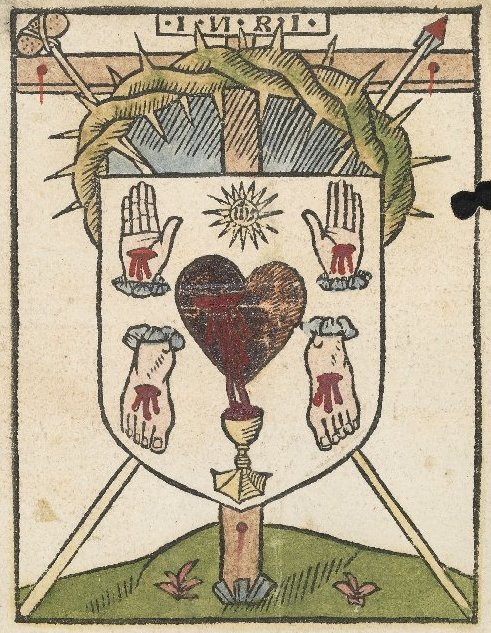
The whole of Christ (the descent) meets the sacrifice of man (the ascent) upon the altar of the heart. We receive the whole of Christ in the Eucharist: we do not receive part of Him, but Him in His entirety. The pre-eminence of His Wholeness — the Essence of All that He Is — is found in his Wounds. In medieval church, these Wounds were offered in symbolic form upon banners of the Five Wounds flown throughout the streets of towns and villages — a declaration of Good News.
This symbol was also offered as a prompt — the sign of humility — upon which and through to make our own ascent to the Heart of Christ. In our ascent within the power of Christ, “we become a whole representation of Christ while still unique and distinct.” (Stan, 129).
Thus it is two holons – two complete realities – which meet and embrace one another in the heart.[13] One is the Bride; the other the Bridegroom; the Church and Christ.
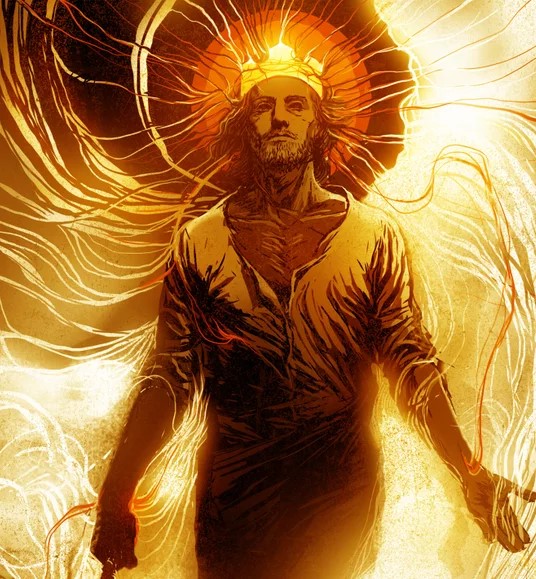
It is here that the Son of Man – that eschatological figure revealed in both the Old and New Covenants of God and an aspect of Christ — appears. The angels descend and ascend upon Him: “Very truly I tell you, you will see ‘heaven open, and the angels of God ascending and descending on the Son of Man.” (Jn 1:51) The Son of Man is a figure of both unity and division. It is He, in a manner akin to the circumcising power of the Logos, who cuts away all that is not of fullness of wholeness – that which is not of the Truth, which is illusory or deceitful or false; He makes possible the wholeness of the Kingdom. It is He who will use the holy angels to separate the faithful from the unbelievers, the just from the unjust; the sinful from the saints. (Max, 92) The Son of Man is a figure of fire, but His is not a judgement which kills, but which rather brings to Life. When the Son of Man comes into the hearts of men and is recognized, the redemption of Time is near. No one knows that day or hour, but then and there will be “God’s righteousness in the plenitude o the Divine Life’s goodness and harmony” (Cab, 67).
The Son of Man is the full/complete consciousness of humanity moving and acting in the cosmos as Love. The Word will live in men’s hearts as spiritual speech which consists in an ineffable word in the heart of the soul (Isaac the Syrian in Shlenov, 216). The Word will go forth out of the heart of man and it shall not return empty, carrying with it the entirety of the Creation, with their True Face and Identity, into the being and banquet of God. It is then that Christ will once more drink of the vine with whole of His Creation.[14]
The Eucharist gives us an intimation of this “blessed and immaculate wedlock” (Max, 80) and the Life-gifting word of the Judge and King. It is the kingdom of heaven within us. (Cab, 148) Man is capable of perceiving this vision in his heart. John the Theologian did so: perhaps he is the norm of the generation which will outwardly and conclusively usher in the Kingdom. But many of us will experience this theoria in ways that we will not comprehend or fully know in this lifetime. We will experience it in iconic ways, as an Image of what is to come.
The theoria of this Vision need not be attained for man to be saved, but, in the deep recesses of our heart, he will have, in the Eucharist, opened himself up to its transformative mark. As Cabasilas writes, “Already they have enjoyed the other delight of the banquet, although they do not obtain it fully yet; but when the Christ has been manifested, they will perceive more clearly what it is they have brought with them.” (Cab, 148) The Kingdom of God has come; but the Wholeness of it is yet an Image for mankind. We actively await the fullness of its Truth.
The garment of skin that is utilized for man’s redemption is that of ritual. Ritual is mankind’s mode of remembering that which he believes is most important for his well-being. It is his attempt to preserve that which is beautiful and lasting. It is also a power-structure of man; key to what he thinks holds meaning and his identity.
The Eucharist, the sacrament of initiation which is participated in again and again by the faithful, transfigures the garment of skin known as Ritual – turning what might be made ossified and rigid by man’s fear into a living encounter between God and man which, in turn, reveals the fullness of Creation.
The Icon of Wholeness: Communion As Remembrance of the Future
The Eucharist is the Sacrament of the Remembrance of Christ in His totality (Zizioulas, 27), not just His words or His deeds. Christ says, “Do this in memory of me” — in this anamnesis , the Eucharist is the bearer of divine Life. But the remembrance of the Eucharist is that of the future, not of the past. The Communion of Man and God as brought into being through the Eucharist is a prefiguring of the salvific events of the eschata: 1) the Wedding Feast of Christ and His Church and 2) the eschatological return of the Son of Man.
It is this remembrance of an eschatological future, which exists now in ordinary Time but which not yet come to fulfillment, which draws all of Creation toward the Church as a moth toward a flame. It is this plenitude – this sense of wholeness, fullness and redeemed identity – which also draws man also to participate in the Church. It is the true Beauty [ever ancient, ever new, Augustine] of God which draws each man to become a living member of the Body of Christ. It is a longing for God born of God’s great love for man. In it exists the promise of the deification which will come without exception to all the worthy.
Conclusion:
The Feast of Corpus Christi highlights the Eucharist’s transformative role in Christian theology, uniting humanity with God and addressing wounds from division and identity loss. Insights from Orthodox theologians emphasize the Eucharist as a means of salvation and healing. It fosters communion with the Divine, urging active participation in the Church’s mission.
“And he took bread, gave thanks and broke it, and gave it to them, saying, ‘This is my body given for you; do this in remembrance of me.’”(Luke 22:19) With these words and these actions, our Lord Jesus Christ instituted the Eucharist/The Sacrament Of The Lord’s Supper to come. He also asked that His disciples meaningfully undertake these actions. The mystery of the Eucharist is characterized by reciprocity[15]: humanity receives from God and it gives onto God; each person receives the Lord’s gifting sacrifice as Body and he gives of their own body (psychosomatic unity) as offering. This reciprocity takes place in both matter and in spirit: it occurs across all time and space; and yet it is anchored in particular time and space with material bread and wine as incarnational media. Eucharistic reciprocity does not take the form of a transaction – it is neither juridical nor equitable in nature: for in his giving, man is actually receiving from God. What man receives, in both the giving and the receiving of which the Eucharist anthropologically consists, is the power to gain Christ in an actualized and incarnational way.[16] To gain Christ is to defeat Death and to receive Life; it is to gain righteousness and be healed of the sin of Adam.
It is in the terms and the quality of eucharistic reciprocity, as instituted by Christ, that the Eucharist’s essential contribution to mankind’s salvation consists. Articulating these terms is a mystery in and of itself: and to unravel the mystery of this salvific event: the Eucharist is a wholeness – a salvific event — which resists analytical dissection and which must be lived in order to be fully experienced; it is a veritable feast for the senses, the soul and the spirit — the Banquet promised by God upon His holy mountain. Despite these challenges and the fundamentally apophatic character of Eastern Orthodox spirituality, the theologians Alexander Schmemann, John Zizioulas, Pannyotis Nellas and Dumitru Staniloae, inspired by the example and writings of St. Maximos the Confessor, have attempted to weave, in whole-picture word-forms, a prayer-shawl of Eucharistic explication. In so doing, the very fabric of Life as given into this Creation is revealed. As expressed by St. Maximos the Confessor, in his Mystagogia, every detail of this moment is essential to the mystery’s efficacy. Essential to them all is the mystery of movement: God’s movement toward humanity, humanity’s movement toward God and what happens between them. Within these movements, facilitated by the Holy Spirit, lie the transfiguring healing and salvation of humanity. They lead man into an experience of the marks of Christ’s Body, the Church: to the oneness, holiness, and wholeness within the world, within humanity itself and within Christ. The gifts of God’s unifying Wisdom flow from the sanctuary; the actions of human being’s redeemed actions in Christ rise up from the nave. The transcendent gifts shift matter’s allegiance from death to life; the earthly offerings restore the divine image in man. The Human Mind, marred by division, is reclaimed; Human Reason, stained by egoism, is restored. Knowledge is given; Virtues are won. In the midst of these saving movements, a wholeness emerges which is the wholeness of God’s eschatological Church – a gift of healing for all the world – of the very fabric of space and time itself — offered by humanity in communion with God. The weaving reveals a Eucharist which is in no way peripheral to the salvation of man – but rather a central event by which the ongoing realization of righteouness in baptized humanity and the Church is effected.
++++++++++++++++++++++++++++++++++++++++++++++++++++++++++
Select Bibliography
Cabasilas, Nicholas. The Life In Christ. Crestwood NY: St. Vladimir’s Seminary Press, 1974.
McPartlan, Paul. The Eucharist Makes The Church: Henri de Lubac and John Zizioulas in Dialogue. Edinburgh: T & T Clark, 1993.
Nellas, Panayiotis. Deification in Christ: Orthodox Perspectives on the Nature of the Human Person. Crestwood NY: St. Vladimir’s Press, 1987.
Saint Maximus, the Confessor. The Church, The Liturgy and the Soul of Man (Mystagogia). Trans. Dom Julian Stead, OSB. Still River MA: St. Bede’s Publications, 1982.
Shlenov, Hegumenos Dionysius. “Isaac the Syrian and Symeon the New Theologian as teachers of stillness,” in St. Isaac the Syrian and his spiritual legacy. Ed. Metropolitan Hilarion Alfeyev. Yonkers NY: St. Vladimir’s Seminary Press, 2015.
Schmemann, Alexander. The Eucharist: Sacrament of the Kingdom. Crestwood NY: St. Vladimir’s Seminary Press, 1988.
Staniloae, Dumitru. The Experience of God Vol4: The church: communion in the Holy Spirit. Brookline MA: Holy Cross Orthodox Press, 2012.
Zizioulas, John D. The Eucharistic Communion and the World. New York: T & T Clark, 2011.
“The human person obtains the state of salvation through grace, and he develops it in the Church through good deeds and gifts.” (120, Stan)
[1] “Church is a figure and an image of God; through her He builds a union between the multiform elements of reality, without fusion, in accordance with His infinite power and wisdom.” (Max, 104)
[2] Flee from self-love, the mother of malice, which is an irrational love of the body. Three Hundred Sayings of the Desert Fathers.
[3][3][3] 2Corinthians5: 21
[4] Jesus, the Bread of Life – John 6: 48-51
[5] The life of the flesh is in the blood. It is the blood that makes atonement by reason of the Life. Lev. 17:11 More will be spoken of this in Theme 2 of this paper.
[6] The pinnacle of Hebrew righteousness is to be seen in John the Baptist and the ever-Virgin Mother Mary.)
[7] The path of Knowledge is outlined in Theme 1 of this paper.
[8] Mystagogia,
[9] Stan, 130.
[10] As St. Maximos writes of it, “In the nave is all that is related to the Word (Logos).” [more explanation necessary]
[11] See Theme 1.
[12] The Christ in man is found within the heart: “The place where Christ dwells as High Priest is the most hidden, purest, innermost chamber of our heart, which alone can be easily sensitized and open to God.” (Stan, 138)
[13] St. Maximos speaks of these two wholes (consisting of five movements each) as forming a decade. (Max, 78)
[14] Luke 22:18 for I tell you that from now on I will not drink of the fruit of the vine until the kingdom of God comes.”
[15] “The human person obtains the state of salvation through grace, and he develops it in the Church through good deeds and gifts.” (120, Stan)
[16] Stan, 126.

