Christ, The Vine
5 “I am the vine; you are the branches. If you remain in me and I in you, you will bear much fruit; apart from me you can do nothing. […] 8 This is to my Father’s glory, that you bear much fruit, showing yourselves to be my disciples.“
John 15: 5, 8
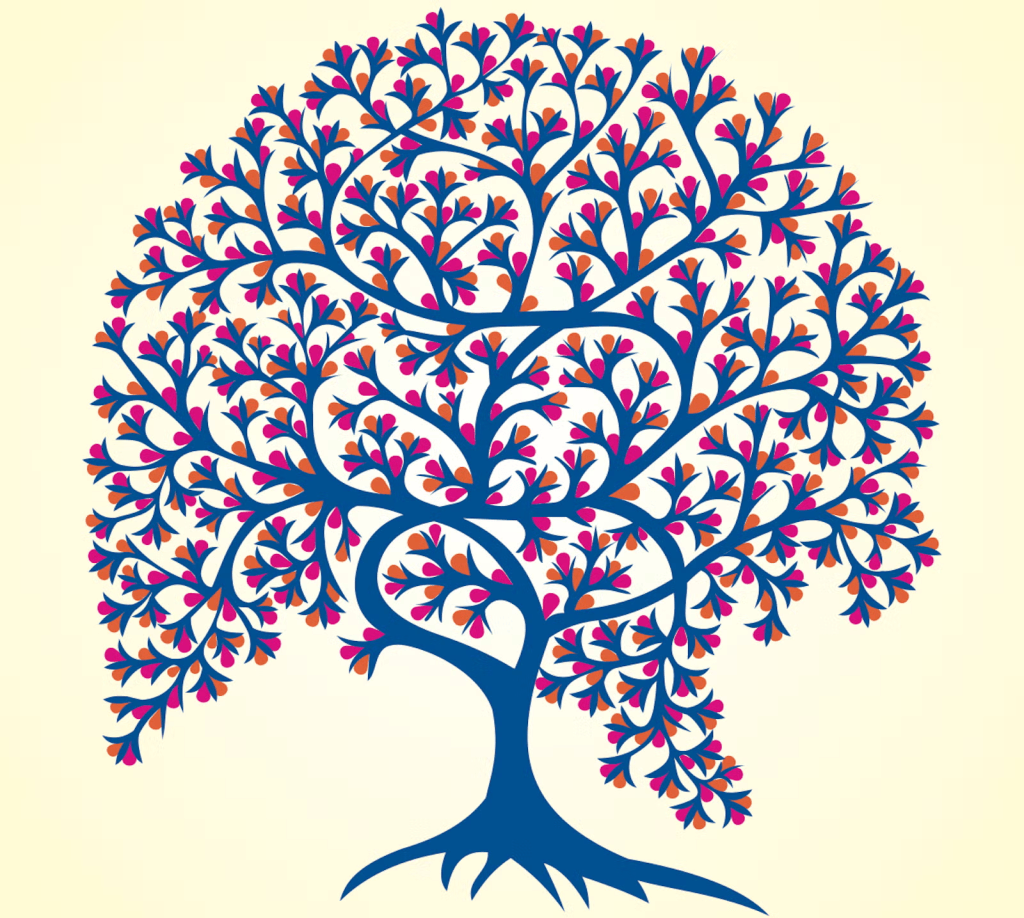
Imagine a tree which bears every type of fruit, good to eat and pleasing to the eye. Imagine that this tree bears fruit in every season and that it is watered by the heart-essence of the Holy Relationship – the Love – between the Divine Persons of God. Imagine also that, despite outward appearances, all the fruits of the tree are all deeply aware of the essence of each others’ life and being. These fruits are in communication with one another – speaking in the sounds, letters and words which were breathed out upon the formation of Creation, as the Logos, the Divine Word, and which are now creating the world anew.
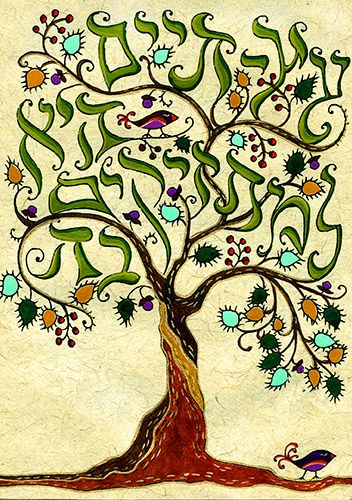
What would it be like to sit next to, under or within such a Tree?
What would it be like to be a part of such a Tree?
Would it not be to taste and sense of the very epitome of Health, Wholeness and Well-Being?
This Tree, in the time of Christ (as these blogs have revealed up until this point) no longer belongs in a walled Plantation, but will be found planted in the Desert –in a place where there appears to be no terrestrial form of water; where there is no Holy City or High-Way by which to find it. The Tree lies at the centre of the Nation of the Heart in the wilderness.
How is it to be found?
For early Christians, Christ was/is/will be this Eternal Tree of Life, but he may as well have been on the Moon – or in the Sun. Christ was of the Pure Life – the Life of the Creator-Father God, and Holy Wisdom.
And the human being had fallen into Death. The chasm was unbridgeable.
This is where the imagery of The Vine becomes so very important – and it explains why this image was so central to the New-Life/God-Life of the early Church.
When Christ says He is the Vine, He is inviting those who seek to love and follow Him into a new type of relationship. They are not merely invited to eat of the Tree of Life and recover their healing and wholeness; they are requested to become a vital part of this Tree. Christ asks that these disciples become Branches on the Tree of Life in the Holy Vineyard – without specific geographical location, but among us – planted by God.
The ‘Plantation’ of God has now become the Temple of each believer, together with the Body (the Trunk, Roots and Vine) of Christ, in the wilderness.
Christ tells His followers they are not to worry about their impurity or lack of worthiness or the taste of death upon them: He reassures them, “You are already clean because of the word [the Word of the Tree of Life] I have spoken to you” (John 15:3). All they must do is seek to be grafted onto the Vine: to let go of their individual lives and become Persons, onto the Son of Man, in the Life of the Tree of Life and its Vine. To be grafted onto The Vine is to be crowned by The Vine: it is to give up one’s headship and to receive the headship/Crown of the True King.
As of yet, not many images of the Vine in early Christian iconography have been found. (This may well be because Vine-imagery was central to a Syriac-Aramaic branch of the early Church that was later persecuted by both Rome and Byzantium.) The Vine-Branch imagery may well have been depicted with images and symbols that we do not yet understand.
We do find what could be considered images of The Vine in the 2nd-century CE catacombs of Rome. In these underground passages, in which persecuted Christians sought refuge, images of doves eating of or resting near a cluster of grapes are found. Some scholars consider this motif to be purely decorative – but this stretches credulity. Very little about what appears on the catacomb walls is random or arbitrary.
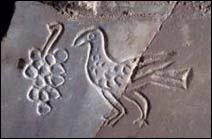
A dove with a cluster of grapes. Inscription from the Catacombs of Priscilla, IV sec. d.c., via Salaria Nova, Roma.
The Dove, as it was in the time of Noah, is always associated with the Peace of God, i.e., the sense of being aligned with God’s Will and Holy Purposes. The Dove is also an image within the Christian Scriptures: Jesus asks his disciples, who are sent out as sheep among the wolves [of the wilderness], to be “wise as serpents, and innocent as doves” (Matthew 10:16). But how could the fallen man – the one who breathes violence, as a beast in the wilderness, the one who seeks his own ‘advancement’ through cunning and deception – ever be innocent? Could he indeed even be wise?
What is the connection between the grapes on The Vine and the [appearance of] the Dove? What comes first?: the Dove eating of the Grape? (and thus becoming the Fruit of the Lord?) Or the Grape being transformed into a Dove? Time is not linear in these settings. We have to let go of our contemporary obsession with causality in order to read this image. Let us instead consider that the Dove and the Grape on the Vine are somehow related – one moving into and continuously becoming the other. The Fruit upon the Vine is also the Dove choosing to be grafted onto it. The Dove appears because the Fruit appears, and vice versa. The fruit matures as the Dove rest upon the Vine’s branches, and bears the fruits of God’s Kingdom-Plantation-Nation, on wings, out into the world.
The Fruit is the redeemed human soul: it is the Grape of Man, pure and alive, before the Time of the Fall. And this is what Christ’s Vine has caused to fruit through His branches – that the disciple-dove-serpent (wise and innocent) will encounter his/her own Self, his/her own Being/Life in God.
The record of this understanding is found in the 2nd-century liturgical hymns of the Syriac Church, The Odes of Solomon. Here is the surviving fragment of the first of these hymns probably first spoken in Aramaic :
The Lord is upon my head like a crown and I shall not be without him.
They [the persons of the Trinity] plaited for me the true crown, and it caused thy branches to sprout in me
For it is not like a withered crown which does not sprout; but thou livest upon my head and thou dost sprout upon me.
Thy fruits are full and ripe, filled with thy salvation. [translation: Carl Schmid]
Is it Christ Himself who is being depicted here? Or is it the faithful disciple? Or is it somehow both?
The Syriac Church retained this understanding well into the 10th-century CE. Forced to flee from the hammering blows and fires of the Byzantine emperors into the Egyptian deserts, the Syriac imagery yet remains as a testament to this theology of The Vine. It is recorded on the walls of some ancient Egyptian monasteries and churches.
In this image, from the Church of the Virgin in Dayr al-Suryan (constructed in Wadi-al-Natrun in the 7th-century CE), the redeemed souls, yet within their bodies (are these their resurrected bodies? or are they yet among the living?), are being fed pure white grapes by either the Trinity or the Patriarchs (Abraham, Isaac and Jacob). (In the Syriac tradition, Paradise is largely depicted, not as an after-death reality, but as something mysteriously contained, as the Kingdom of Heaven, within this world.)
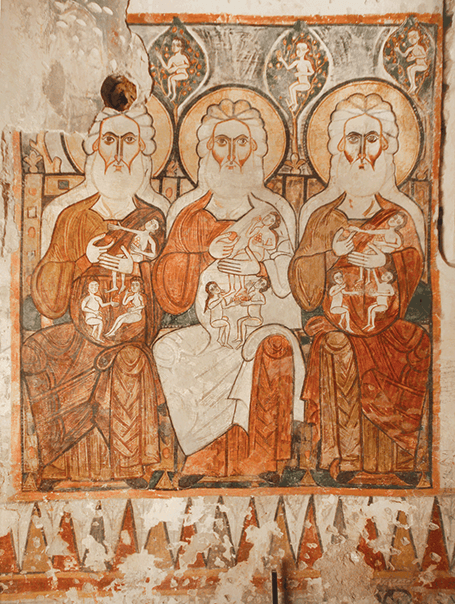
Fresco, North of the Altar, The Church of the Virgin in Dayr al-Suryān (Wadi al-Natrun, Egypt)
Arguably, the fruits being fed to these souls are their own pure selves – now become their nourishment, their true source of Life.
Much of this history is being obscured and corrupted in our time – by Islam and within Christianity itself. What I share here was told to me by teachers within the East Syriac Rite, and by participants within the St. Thomas Churches of India.
Through the Vine, which is Christ, all the branches are united to one another. The believers may give the appearance of being separate, but, while retaining their distinctness, they are made One – One in Body and One in Spirit.
In this Oneness, they share in the Love and Power of Christ. In this way, they become little Christs, carrying His teachings, His miracles and His healing in their very being and personhood. They give Glory to God: they are One in order that the world may believe that the Father-God sent Christ as His Son and the Son of Man into this world [paraphrase of John 17: 21].
As Christ told His disciples, “ If you remain in me and my words remain in you, ask whatever you wish, and it will be done for you.” (John 15:7). The disciples, by having become branches of the Vine, are already living in and through the Will of God: the very things they are seeking and asking for will now be the things of the Kingdom, the New Holy City, the New Jerusalem, carrier of God’s Joyful Life and Reviving Word for all the mourning world.

