5 “I am the vine; you are the branches. If you remain in me and I in you, you will bear much fruit; apart from me you can do nothing. 6 If you do not remain in me, you are like a branch that is thrown away and withers; such branches are picked up, thrown into the fire and burned. 7 If you remain in me and my words remain in you, ask whatever you wish, and it will be done for you. 8 This is to my Father’s glory, that you bear much fruit, showing yourselves to be my disciples.”
John 15: 5-8
+++++++++++++++++++++++++++++++++++++++++++++++++++++++
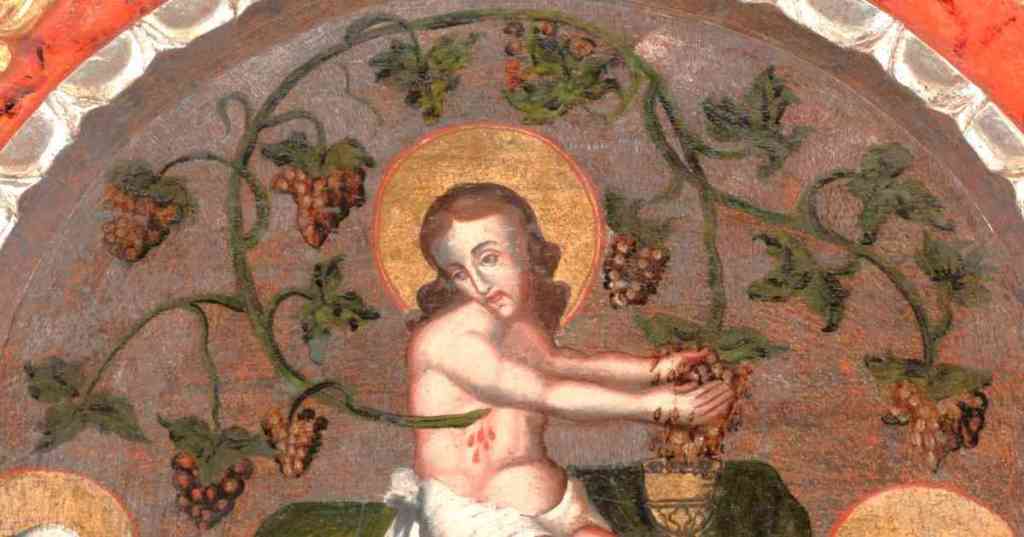
Christ, The True Vine, Part 1
This is Part 1 of this meditation/reflection on the central Christian image of The (True) Vine. Parts 2 & 3 will follow in the weeks to come.
From the eighth century CE onward, True Vine imagery for Christ was conflated with that of the All-Embracing World Tree (the Redeeming Cross). For the sake of Eucharistic catechesis, this conflation process began early in the history of the Church: in 385 CE, Bishop Ambrose of Milan (339-397 CE) indicated that, if one were to secure the link between Christ’s sacrifice on the Cross with the ongoing sacrifice performed in the Eucharist under the appearance of wine, it would be helpful to imagine Christ on the cross as a vine growing on a trellis.
One can certainly perceive how Ambrose’s pedagogical suggestion might facilitate the lay person’s understanding of challenging sacramental theology. However… and it is a significant however … while the two images (Vine and Tree) certainly do much to fructify one another (pun intended!), they are not the same.
The All-Embracing World Tree (the Redeeming Cross) is an image which suggests that it is in sharing in the sufferings of the Crucified Christ that one becomes a branch of His Vine; a bearer of the fruits of God’s Kingdom, the fruits of the Holy Spirit. This Christ, out of great Love and out of the depths of endless compassion, takes on the entire sin of the world; He receives all darkness, all blows and all iniquities. Through His sacrificial act, the barren cruel Cross, upon which He was given to die, becomes the Tree of Life. This Tree of Life, in turn, becomes the source of unity and consolation amongst all true Christians — a taste of Paradise in this world before thew world to come. This is a beautiful theology, taken up by both the Western and Eastern churches, images of which are depicted in the three frescos/paintings below.
The Protestant church, struggling with the weight of traditional iconography (and its imputed idolatry), abstracted this understanding of abiding with the suffering Christ into ‘abiding in the Word’: the Word (often synonymous with Scripture) is to be meditated upon continually in order that one might bring one’s entire life and faculties, by God’s grace, under the aegis of Christ.
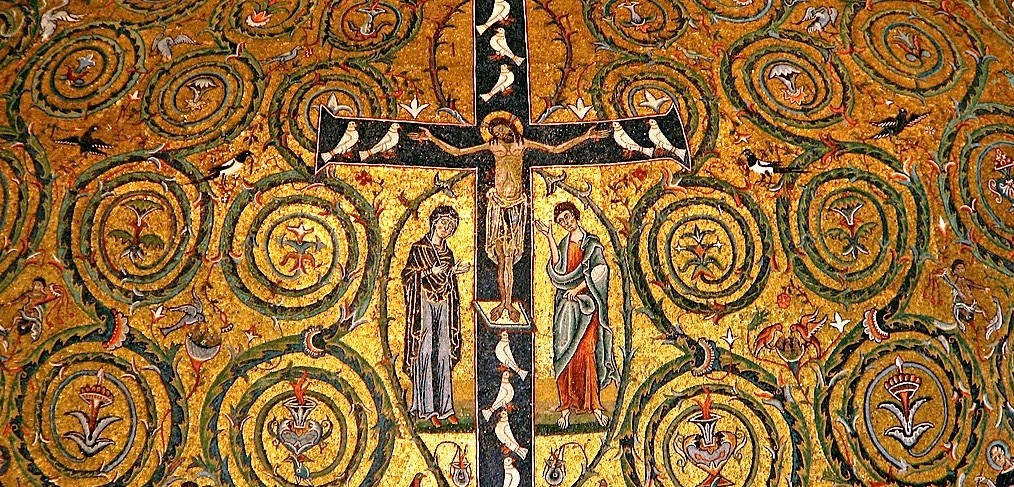
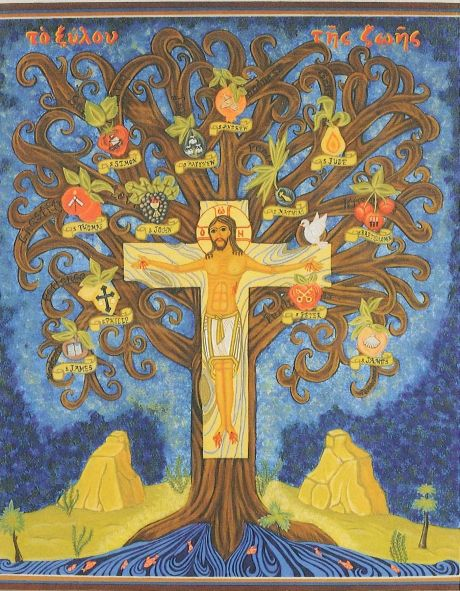
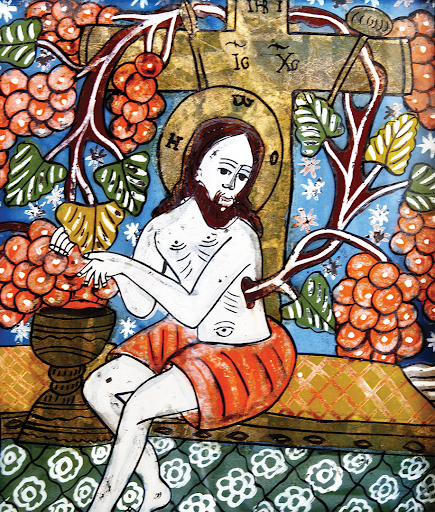
“Jesus the Vine.” Romanian icon on glass, 19th century.
In the conflation that occurred, the Tree of Life or the Word (with which the Christ is contiguous), is the True Vine referred to in John 15. But while there are indeed overlapping motifs in these images, something essential was lost in the process.
In this blog, I argue that the conflation-process has cost the Christian Church significant insights into the nature of God’s Kingdom; it has also denied us an image of an active discerning (Semitic) Christ, who is more than capable and willing to separate the sheep from the goats; a Christ who does not suffer fools gladly; and who clearly knows the difference between Good and Evil.
Alternatives to this conflation-erasure, continued to exist in the Syriac, Nestorian, Ethiopic and Coptic churches – but these churches’, heavily persecuted by both Rome and Byzantium/Constantinople, and their imagery were not permitted to inform the mainstream consciousness of the Christian Church.
The reclamation of the True Vine imagery – separate from its attenuations in the Tree of Life, World-Tree, and Redeeming Cross – is what this blog entry is all about.
The Tension Between Inclusion and Exclusion in the Early Christian Church
I give you fair warning: this interpretation of The True Vine is not one that is going to be palatable to most contemporary tastes. (Be aware of your own sympathies and antipathies – as outlined in this blog’s Visio Divina page. Share them with God; ask for the guidance of the Holy Spirit: allow your discomfort with these teachings to draw you into closer relationship with Christ.)
In the Western world, Inclusion (and its associated Tolerance) are the social virtues par excellence. It is serious faux pas to set boundaries/limits on others’ voicing and participation – particularly if they are ‘different’ from you. Setting limits is not hospitable, it is not kind, it is unwelcoming and unchristian: I have heard all these things said by members of numerous Christian communities.
Since it is really a secular interpretation of Christianity (and its All-Embracing World Tree theology) that has given rise to this deep-seated ‘ethics of inclusion’ (see Tom Holland’s Dominion (2019)), it is more than interesting to see how, in the early Church, exclusion, rather than inclusion, was the motif through which the imagery of Christ’s I AM statements (including “I am the vine”) was interpreted.
The Seven I AM statements – “I am the bread of life” (John 6:35); “I am the light of the world” (John 8:12); “I am the door of the sheep” (John 10:7); “I am the good shepherd” (John 10:11, 14); “I am the resurrection and the life” (John 11:25); “I am the way, the truth, and the life” (John 14:6); “I am the true vine” (John 15:1) – can mean pretty much anything if taken out of their scripture and cultural context. Who are the sheep? What world are we talking about? What’s meant by life? I could go on. Confusion and ambiguity can reign in this vast endlessly-multiplying world of living metaphor – a world that makes little sense to the materialist, prosaic and literal mind of most twenty-first century people. When I was in a Baptist seminary, most MDiv students dreaded preaching on them. The statements themselves were ridiculed by twentieth-century demythologizing Biblical ‘scholars’ as hyperbolic, post-Resurrection addendums written by some of the apostles (or their successors) to accent – yea, even prove – the divinity of Christ to their listeners. In Jesus’ own time, the statements would have been considered blasphemous: a human being attributing the divine I AM the I AM of Exodus 3:14 to himself?
Each of the signifiers of the I AM statements has a specific cultural context: ‘bread’ (Bethel, House of Bread) referenced something particular in the lives of the historical Christ-followers/learners/disciples, so did ‘door’, ‘sheep’, ‘shepherd’, ‘way’, ‘life’, etc. ‘Vine’ is/was no exception.
The Separation of the Cultivated and the Wild:
God’s Kingdom vs. the Fallen Creation
The Vine referenced in John 15 is not to be found in the wilderness. Instead, with this image we enter the whole world of intentional agri-culture and cultivation – we enter the realm of ‘civilization’. Isaiah 5, from which the Johannine image of Vine is drawn, teaches us that there are wild grapes (the smelly, inedible, useless fruit of disobedience to God), and cultivated grapes (good fruit) which are the useful produce of those who have been faithful to God’s covenant. Without intentional/divine cultivation, good fruit which brings forth good wine – a product which in the world of Jesus was not merely a luxury, but a necessity – will not grow and cannot be harvested.
We have become quite soft-eyed and hearted about Nature in our own times, but the folk of the early Common Era suffered no such illusions. In ancient Near Eastern theology, the ‘world out there’ was not a hospitable giving place. The ‘world out there’ was a place of weeds (botaneia, Grk), savage beasts, terrific monsters – a place of death. Where was life to be found? In crafted oases, carved out of the wastelands, made to bloom. Clear boundaries needed to be set between the reclaimed/redeemed world of the oasis and that of savage Nature. In these redemptive activities of agri-culture, humanity was not unlike God: in Job (one of the oldest books in the Bible), we hear of God shutting up the chaotic sea behind doors (Job 38: 8-11); He sets boundaries that the waves cannot pass (Jeremiah 5: 22).
A part of creation that exists in and through the rule of God is an ordered constructed place, a plantation (psouteia, Grk). This is a word that is very difficult for our post-colonial twenty-first century consciousness to stomach: when we hear this word, we think of hard labour, slavery, the toil of the oppressed and exploited in the unrelenting sun; for the ancient world, however, a plantation that ran well, kept the forces of chaos at bay, and was productive (i.e., was able to feed its people) was the sign of a Good Master.
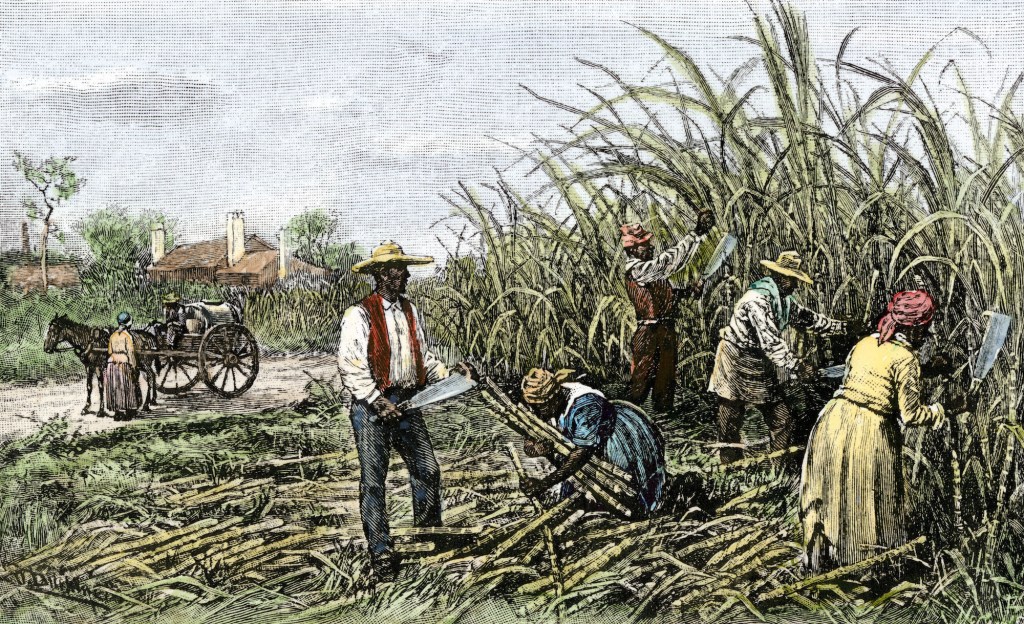
Can we abide such images today?
If we cannot accept the validity of the humanly-run plantation, are we able to find the traces of the Holy Spirit within the image of the Divinely-run and -ordered plantation?
It is not surprising then that we hear these words ‘plantation’/’planting’ abundatnly referenced in the Judaism of the time of Christ. I cannot do justice to all the references in this blog, but they are to be found in both canonical and extra-canonical sources of the first to early third centuries CE: in the canonical Books of Isaiah and Ezekiel; in the Hodayoth (Thanksgiving Psalms of Qumran); in the Ascension of Isaias (preserved in the Ethiopian Christian community); in the Psalms of Solomon (Alexandrian Jewish community); in the writings of Hippolytus of Rome, Origen, and Cyril of Jerusalem. [See the work of Jesuit scholar, Jean Danielou, Primitive Christian Symbols (1961).]
By the time of Christ, and even in the centuries after the time of the Babylonian Captivity (586-538 BCE), the plantation system has begun to break down. The Good Master is no longer in control. Even the sovereignty of the Good Master God is questioned. Significantly, as early as 700 BCE, in Isaiah 5, we hear that the wild grapes are infesting the sectioned-off and protected vineyard – the nation of Israel – which God Himself had planted. These are not just sour grapes, a bit pithy, or difficult to process; they are stinking, rotten, be’ushim (Isaiah 5:2). How has this happened? How has the plantation-system — the boundaries of plantation — been so grievously assailed?
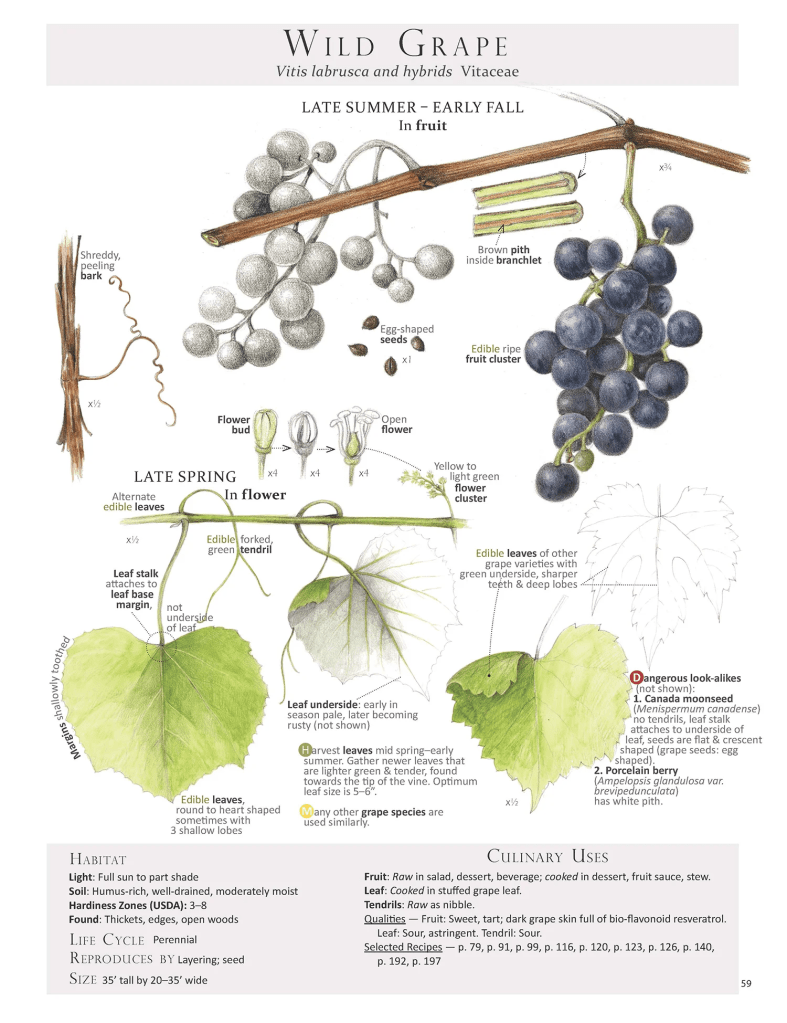
While today we might say, “How can we cook something or prepare something with these wild grapes?”, the concern about the corruption of the vineyard is far more existential in ancient times. Their questions were urgent: “What can be done? How can the breach — the smashed boundaries — be mended? How can God ensure that His plantation is not taken over by this invasive species? this Aggressor, these “children of the Lie”, that have no part of Him?”
God needs a Vine that cannot be corrupted by the invading wild grapes; a Vine that refuses to cross-pollinate with the Enemy. He needs a True Vine — a Vine Whose nature always remains true to Him; a Vine that has the power and truth of Being to maintain the definition of territory between the wild and the cultivated.
Enter Jesus. Enter the Christ. ….
Those who abide in Christ’s Vine will maintain their purity. Those that do not will be corrupted by the wild grapes. If corrupted, these branches cannot produce good fruit: they are to be cast off and burned (John 15: 6). The Vine is the dividing rod between those belonging to God and the profane.
But how do we square this discriminating Vine of Christ with the All-Embracing image of Christ that many of us have been raised with? How can this Vine which embraces the Sheep but which forsakes the Goats be a metaphor for the Lord of Love?
These questions will be explored in Part 2 of this blog in which we will explore the early Roman and Syriac understandings of Christ as The True Vine, and the nature of God’s ‘plantation’.
End of Part 1…
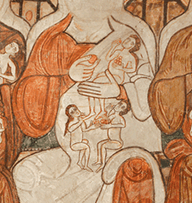
From a fresco-icon of the Three Patriarchs (Abraham, Isaac and Jacob) at Wadi-al-Natrun Monastery of St. Mary of the Syrians/Monastery of the Syriacs (Dayr al-Suryān), Egypt ca. 8th-century CE.
The content reflects on the Christian imagery of Christ as the True Vine, as described in John 15:5-8. It contrasts this with the All-Embracing World Tree, arguing that conflating these symbols has obscured key theological insights. The author emphasizes the distinction between cultivated and wild grapes, illustrating that true discipleship involves remaining connected to Christ for spiritual purity and fruitful living. Further exploration of this theme is anticipated in subsequent parts.
 Christ: Lost and Found