“No one has ascended to heaven but He who came down from heaven, that is, the Son of Man who is in heaven. And as Moses lifted up the serpent in the wilderness, even so must the Son of Man be lifted up, that whoever believes in Him should have eternal life.” John 3: 13-15 NKJV
“Son of Man”: The Name the Church Forgot….
Jesus refers to Himself as the Son of Man 86 times in the Gospel. Far more than any other, this is the preferred title which Jesus uses to designate Himself. And yet… even in the earliest Church documents that contemporary theologians consider orthodox, Son of Man is hardly mentioned at all.
How can we account for this?: this is a question which concerns Biblical scholars and theologians.
The practical outcome of the omission is that the imagery of the Son of Man has not been brought fully into Christian worship, devotional practice or popular understanding of Christ.
This blog-entry will only touch on the surface of this Image. It will be returned to again and again throughout every blog-entry to come — and that is why I choose to begin the blog entries with this brief, all too cursory, ‘introduction’ to the Imagination of the Son of Man.
What is meant by the phrase “Son of Man” in the Christian Gospels?
We know that the phrase is not Greek in origin. The original language of expression in the Gospels was likely Jesus’ Aramaic — bar enas (nasha); son of the human. (Its Hebrew equivalent: ben Adam; son of Adam, the Human Being.) Enas in Aramaic is in the same word family as nasa — to carry, bear, lift or take up. Ironically, nasa also has a different root — to deceive or beguile. As with so many Semitic words, there are layers of allusion in this word, enas. The Greek can only translate it as ‘andropos‘, i.e. Man.
What to a Western mind might appear as frustrating ambiguity, points us toward a multivalent understanding of the title, Son of Man. The concept-principle of Son of Man is not straightforward. But rather than wrestle it analytically into a form of “manageable complexity”, let us instead invite an artistic perspective of “unmanageable simplicity” (to use Carmelite priest Bruno Barnhart’s words).
Let us look to the whole of this title for Christ; let us invite this Imagination into our prayer, into our thoughts, into our lives.
An Earthly Understanding of ‘Son of Man’: Son of the Human Being
On one level, the term Son of Man refers to any human being: I am a son of Man; a member of the human species. On another level, it can be taken as a general principle — Son of Man refers to Everyman: the Common Man of Bolt’s Man for All Seasons, the Chorus in a Greek tragedy; a Willie or Winfred Loman (from Arthur Miller’s Death of a Salesman). This is an amorphous figure upon which any dream or hope might be pinned; an expression of the tragedy and (often pseudo)-heroism of any human life.
So Jesus is all these things: He is the No One that lives No Where; but He is also the particularity of one Incarnation, all too painfully constrained by the limits of His one very short life. “Foxes have holes and birds of the air have nests, but the Son of Man has nowhere to lay His head” (Matthew 8:20).

But there is another understanding of Son of Man. We hear it in the Book of Daniel, and also in the extra-canonical, but certainly widely read in Jesus’ time, books of Enoch. I cannot go into the Enoch imagery here — I will return to it in later blogs. But I will share the Daniel passage (Daniel 7: 13-14, NKJV):
“I was watching in the night visions [an interesting context!],
And behold, One like the Son of Man,
Coming with the clouds of heaven!
He came to the Ancient of Days,
And they brought Him near before Him.
Then to Him was given dominion and glory and a kingdom,
That all peoples, nations, and languages should serve Him.
His dominion is an everlasting dominion,
Which shall not pass away,
And His kingdom the one
Which shall not be destroyed.”
In the Book of Daniel, the likeness of the Son of Man comes with the clouds of heaven. (Is He rising? or falling?: we cannot tell.) And this Son of Man approaches the Ancient of Days, i.e., the Divine Being from Before Time, the Eternal — sometimes depicted as an Old Man with Snowy White Hair and Beard sitting on a Throne. These depictions were not meant to be taken literally, but were signs and symbols of an ineffable reality behind and above all Creation.
‘Son of Man’: Cosmic Archetype?
In this Imagination, we are tapping into a vision of the Cosmic Human Being — made in God’s Image, Male and Female, as recounted in Genesis. This understanding can be found in the writings of the Essenes, and also in Syrian-Palestinian baptizing movements of Jesus’ time. The Son of Man is primordial Man — Man from the time before the Fall; even more radically (i.e., at root), Man in the eye-heart of God before the beginning of Time. (For some Hebrew/Jewish Kabbalists, this Man came to be known as Adam Kadmon.) This understanding of Cosmic Man (Cosmic Adam) remained within the Church as late as the High Middle Ages — as seen in this thirteenth-century manuscript from Rhineland Germany below.
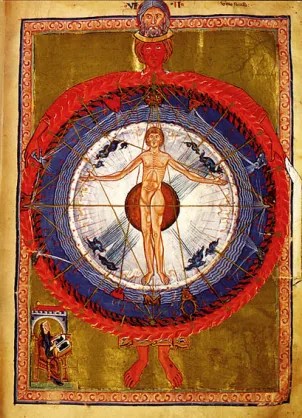
This Cosmic Human Being, once Whole, became fragmented over and within Time. It became definitively fragmented with the Fall of Adam/Eve in the Garden of Eden. With that act, the human being fully descended into matter — and the wholeness of the Son of Man was shattered into particular shards; shards which the pessimists among us said were not holograms, in that they no longer carried the image of the Whole (the One). Others, like the early Church Fathers, were more hopeful: they believed individual human beings yet carried the image of the One (the Whole), but that it had become obscured. What could bring it to Light — bring human beings back to Personhood in God — again?
The early followers of Christ — those who knew of this teaching concerning the Primordial Man, Adam Kadmon and who called themselves gnostics, i.e., knowers (not to be confused with the dualistic Gnostics of the 3rd-century onward) — recognized in Jesus Christ the re-collected Son of Man: in Him, the shards of Adam had been re-collected and reconstituted (first incarnated in an earthly form and then giving rise to a cosmic reverberation) into the redeemed Archetype of the Human Being before Time and the Fall.
Through the descent-coming of the Cosmic Human Being into Creation, all of Matter and Wisdom (the latter often pictured as a red sheath, or an enthroned and crowned female figure with a Scarlet Face in orthodox iconography) informing/guiding Matter are redeemed. Through the advent of the Son of Man, Sophia-Wisdom becomes Hagia Sophia, Holy Wisdom. Jesus Christ, as Son of Man, signifies the coming of a world-order based upon holy and divine principles. (And one might well ask, if that is so, where is it? — we will return to this question in later blogs.)
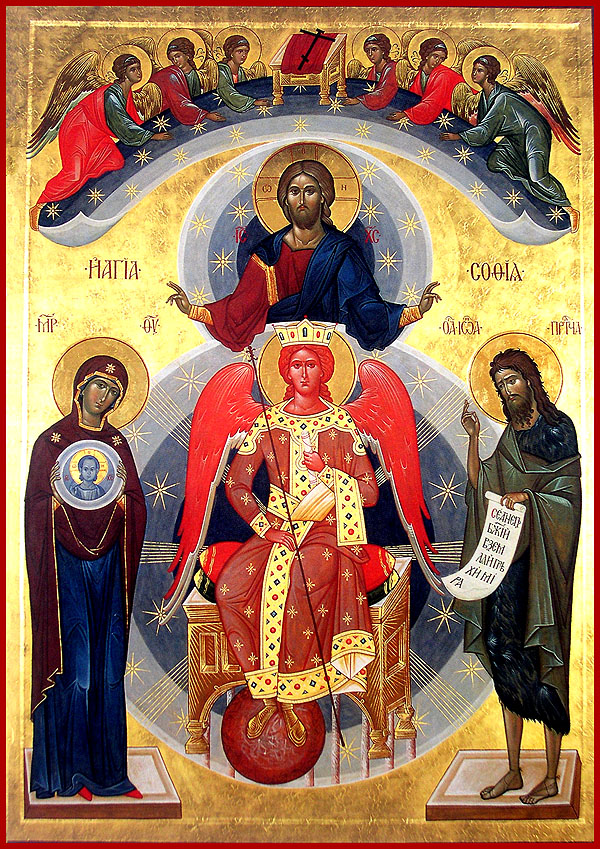
Jesus Christ is the lived experience of the True Divine Order — an ontology — generally applicable to all human beings, but made Powerful and Real through His specific Incarnation. Thus what the Church later called “the scandal of particularity of Jesus” — that Christ was born into a particular place and tradition and therefore his teachings could be applicable to all human beings — is no scandal at all. The Incarnation is particular; the implications are Cosmic.
What Kind of ‘King’?
In Mark’s Gospel, Jesus begins to teach the disciples about the Son of Man after He asked them Who they think He is. He asks them to engage their Imaginations in order that they might begin to receive the fullness of What/Who He Is.
“Now Jesus and His disciples went out to the towns of Caesarea Philippi; and on the road He asked His disciples, saying to them, “Who do men say that I am?” So they answered, “John the Baptist; but some say, Elijah; and others, one of the prophets.” He said to them, “But who do you say that I am?” Peter answered and said to Him, “You are the Christ [the anointed One, the Messiah]. Then He strictly warned them that they should tell no one about Him. And He began to teach them that the Son of Man must suffer many things, and be rejected by the elders and chief priests and scribes, and be killed, and after three days rise again. He spoke this word openly.” Mark 8: 27-32a
Why does Jesus forbid His disciples to speak about Him as the Messiah — yet He speaks openly about being The Son of Man (who must suffer and descend into Death, the most material and finite of all realities in the ancient Jewish worldview).
There is a linking between the idea of Jesus as Messiah and this title The Son of Man, but the pairing, and Jesus’ interdiction about the voicing of one of these titles and His open confession of the other, forces the witness to think of Messiahiship in a different way.
This is no merely earthly King — His Kingship is rather Cosmic, while yet manifesting in and within Creation.
Can we even appropriate the term Messiah when we speak of Jesus? Can we use such a term to describe Him when that term was so bound up in ideas of earthly rule and an earthly Kingdom? In Christ, do we instead find a new Leader into the wilderness of Divine Realities? — into a new Promised Land?; do we find a new Moses who leads His people — lifted up as their Guide and Model/Archetype — to freedom out and through the desert?
The words “I am” (v. 29) are also revealing — they link these titles for Christ (His hybrid Cosmic Messiahiship) with Jesus’ I Am statements of John’s Gospel that point us toward Jesus as the Son of God. And they also connect us with the New Man of Whom Paul writes so frequently in his letters/instructions, e.g., Ephesians 2:15, Ephesians 4: 22-24, 2 Corinthians 5: 17, Colossians 3: 10 — our new identity in Christ.
Is the Son of Man a singular hero? Or does He stand in for a collective? Or is He a concept-principle that can be realized in every human being? All of the above? Or none?
“Who do you say that I Am?”
Who do you say Christ is? How does this Imagination of The Son of Man inform your answer?
 Christ: Lost and Found